Men’s gymnastics is one of the most demanding and visually impressive sports in the world. It combines strength, balance, flexibility, coordination, speed, and precise technique. In major competitions, male artistic gymnasts compete across six different events. Each event tests a different combination of physical ability and technical skill.
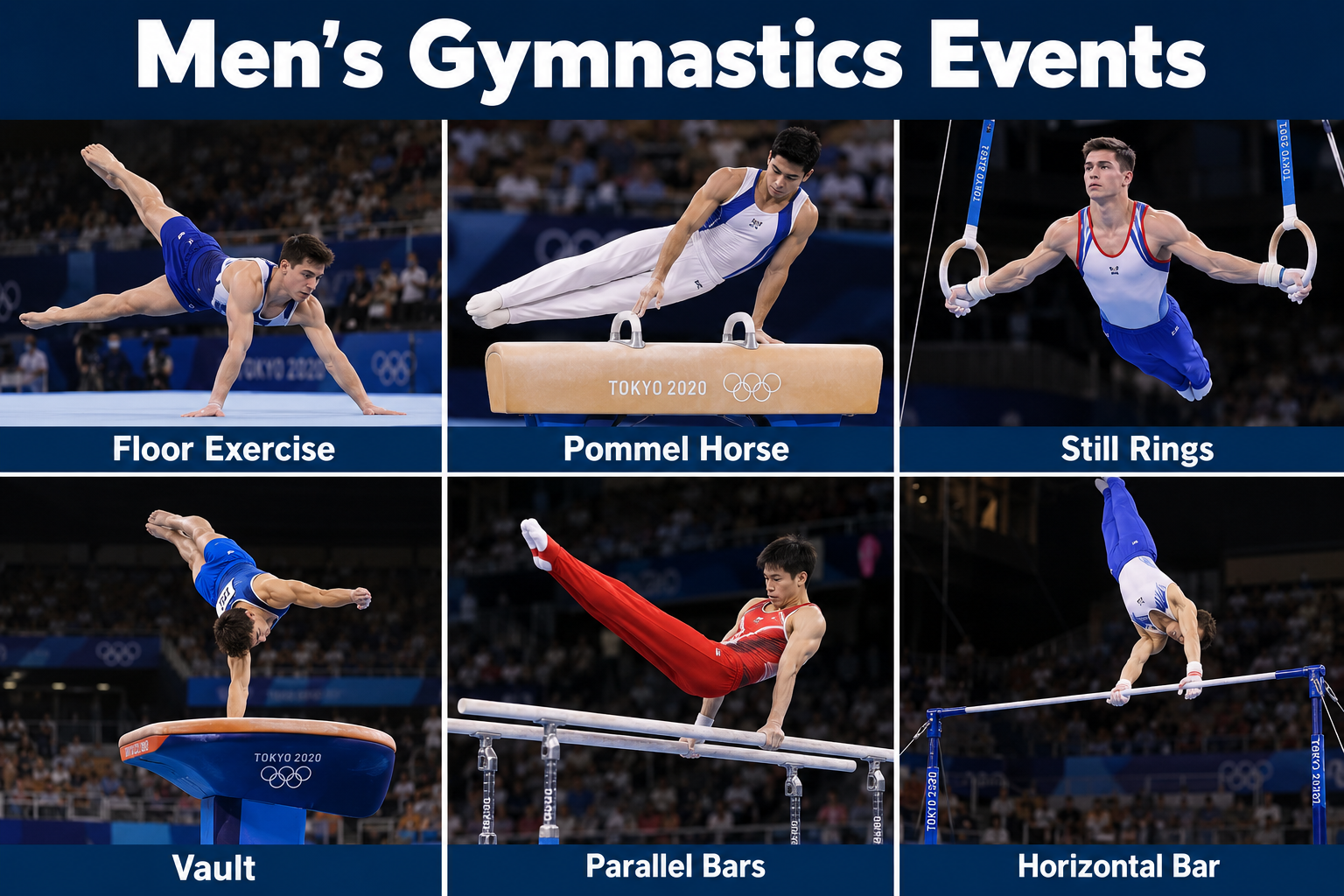
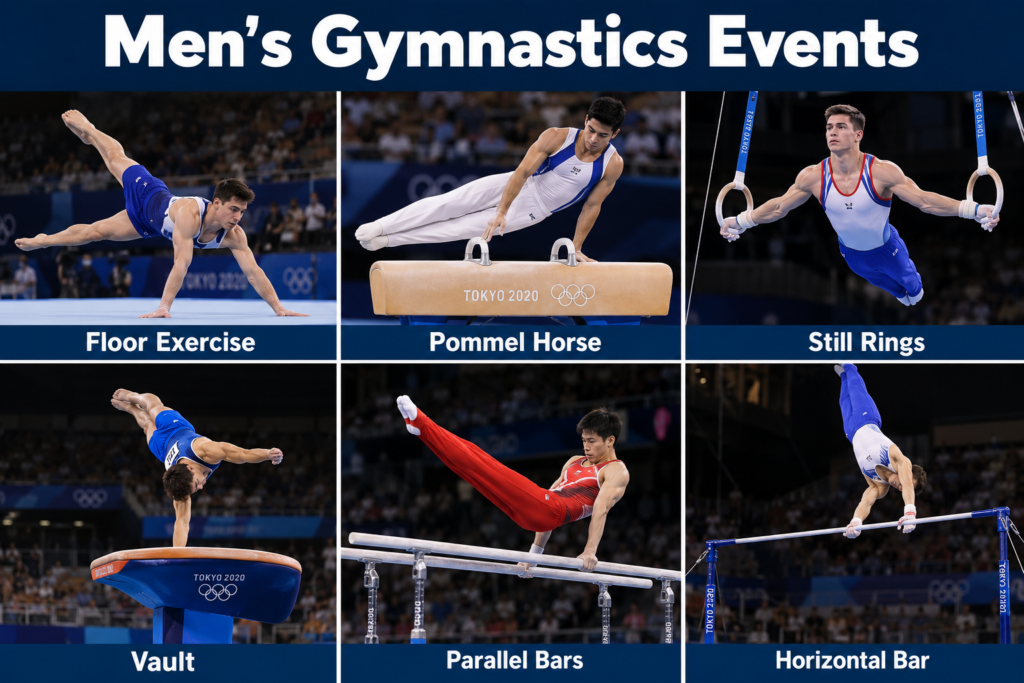
The six main men’s gymnastics events are floor exercise, pommel horse, still rings, vault, parallel bars, and horizontal bar. Together, these events form men’s artistic gymnastics. Athletes may compete in all six events as all around gymnasts, or they may specialize in one or more apparatus.
Understanding each event helps viewers appreciate how difficult gymnastics really is. A routine that lasts less than a minute may represent years of training, repetition, strength development, and technical refinement.
1. Floor Exercise
Floor exercise is one of the most recognizable events in men’s gymnastics. It is performed on a large square spring floor that gives athletes enough bounce to complete powerful tumbling skills.
Unlike women’s floor exercise, men generally perform without music. The focus is mainly on tumbling, strength, balance, flexibility, and control.
A typical men’s floor routine contains several tumbling passes. These may include flips, twists, handsprings, and combinations of multiple airborne skills. Gymnasts usually travel from one corner of the floor to another while performing these passes.
Between tumbling sequences, athletes may demonstrate strength and balance elements. These can include handstands, press handstands, circles, and controlled positions close to the floor.
One of the biggest challenges of floor exercise is landing. Gymnasts are expected to finish difficult tumbling skills with excellent body position and as little movement as possible. Taking extra steps or losing balance after landing can reduce the score.
The gymnast must also stay within the boundaries of the floor area. Stepping outside the marked area may result in a penalty.
Successful floor gymnasts combine explosive leg power with strong core control and body awareness.
2. Pommel Horse
The pommel horse is often considered one of the most technically difficult men’s gymnastics events. The apparatus looks somewhat similar to a padded horse with two handles, known as pommels, attached to the top.
During the routine, the gymnast supports the body mainly with the hands while continuously swinging the legs around the apparatus.
Circular movements are a major part of pommel horse routines. Gymnasts perform circles with straight legs while transferring their weight from one hand to the other.
Another common movement is the scissors technique, where the gymnast moves the legs in opposite directions while supporting the body on the pommels.
Advanced athletes perform combinations that travel from one end of the horse to the other. They may also perform movements on the leather sections of the horse instead of staying only on the pommels.
Continuous rhythm is extremely important. A gymnast who loses momentum may struggle to continue the routine.
Falls are particularly costly because the gymnast must stop, remount the apparatus, and continue.
Pommel horse requires strong shoulders, wrists, arms, abdominal muscles, and excellent coordination. Even though the legs rarely touch the apparatus, their position must remain controlled throughout the routine.
3. Still Rings
Still rings are known for requiring extraordinary upper body strength.
Two rings hang from long straps above the competition floor. The gymnast begins the routine by gripping both rings and performing a combination of swinging skills, strength holds, handstands, and transitions.
One of the main goals is to keep the rings as still as possible during strength positions. Excessive swinging of the rings can make a routine look less controlled.
Some of the most famous ring elements involve holding the body completely still in difficult positions.
The iron cross is one well known example. In this position, the gymnast holds the arms straight out to the sides while keeping the body vertical.
Another challenging movement is the planche, where the gymnast supports the body with straight arms while holding the body approximately parallel to the floor.
Strength positions must normally be held long enough to clearly demonstrate control.
However, rings are not only about strength. Gymnasts also perform powerful swings, handstands, and release movements before completing a dismount.
The dismount usually involves releasing the rings and performing flips or twists before landing on the mat.
Still rings demand exceptional shoulder strength, arm strength, core stability, and body control.
4. Vault
Vault is one of the fastest men’s gymnastics events.
Unlike routines on other apparatus, the vault may last only a few seconds. However, the athlete must generate enormous speed and power during that short period.
A vault begins with a sprint along the runway. The gymnast then jumps onto a springboard and places the hands on the vaulting table.
After pushing away from the table, the gymnast performs flips, twists, or combinations of both before landing.
The quality of the run is extremely important because speed helps generate the energy needed for difficult vaults.
Gymnasts also need an explosive push from the vaulting table. A strong push allows them to gain height and distance before completing aerial movements.
Judges look at several factors, including body position, height, distance, technique, and landing control.
A good vault should appear powerful and controlled.
Landing is often one of the most noticeable parts of the performance. Ideally, the gymnast lands upright with both feet together and minimal movement.
Large steps, falls, or poor body position can significantly affect the final score.
Vault training requires sprint speed, leg power, shoulder strength, courage, and precise timing.
5. Parallel Bars
Parallel bars consist of two long bars positioned next to each other at the same height.
Gymnasts perform routines that combine swinging movements, handstands, strength elements, release skills, and transitions between different positions.
The gymnast may support the body above the bars with straight arms, swing underneath the bars, or move through handstand positions.
Handstands are particularly important because many skills begin or end in a controlled handstand.
Advanced gymnasts may release their grip from the bars during a skill and then catch the bars again.
These release movements require excellent timing because the gymnast must calculate exactly when to let go and when to reconnect with the apparatus.
Parallel bars also require coordination between the arms and shoulders. Small mistakes in hand placement can interfere with the rhythm of the entire routine.
At the end of the routine, the gymnast performs a dismount involving flips or twists before landing on the mat.
Successful parallel bar routines appear smooth and continuous. The athlete should move from one skill to another without unnecessary pauses.
6. Horizontal Bar
The horizontal bar, also called the high bar, is one of the most exciting men’s gymnastics events.
The apparatus consists of a single metal bar positioned high above the floor.
Gymnasts perform large swinging movements around the bar called giant swings. These movements create the speed needed for advanced release skills.
During release elements, the gymnast lets go of the bar, performs a flip or twist in the air, and then catches the bar again.
These skills can look spectacular because the athlete may travel high above the apparatus before returning to the bar.
Grip changes are another important part of high bar routines. Gymnasts frequently change the direction or position of their hands while continuing to swing.
Body position must remain controlled during each movement.
At the end of the routine, the gymnast releases the bar for the dismount. High level dismounts often include multiple flips and twists.
The gymnast must then land securely on the mat.
Horizontal bar requires grip strength, shoulder flexibility, timing, courage, and strong spatial awareness.
The Men’s All Around Competition
Some male gymnasts compete on all six apparatus. These athletes participate in what is known as the all around competition.
Their scores from floor exercise, pommel horse, still rings, vault, parallel bars, and horizontal bar are combined.
Being an all around gymnast is extremely challenging because each event demands different abilities.
For example, rings require tremendous upper body strength, while vault depends heavily on speed and explosive power. Pommel horse requires continuous rhythm and technique, while high bar depends on swinging ability and precise timing.
An athlete who performs strongly across all six events must develop an unusually balanced range of physical and technical skills.
How Men’s Gymnastics Is Scored
Modern artistic gymnastics scoring considers both difficulty and execution.
The difficulty component reflects how technically challenging the routine is. Gymnasts can increase their potential score by including harder skills and combinations.
Execution evaluates how well those skills are performed.
Judges may deduct points for mistakes such as bent arms, separated legs, poor body position, loss of balance, steps on landing, or falls.
This means gymnasts must balance difficulty with consistency.
Attempting extremely difficult skills may increase the possible score, but mistakes can reduce the final result.
For this reason, routine construction is an important part of competitive strategy.
Physical Skills Required in Men’s Gymnastics
Men’s gymnastics develops nearly every part of the body.
Upper body strength is essential for rings, parallel bars, pommel horse, and horizontal bar.
Leg strength and explosive power are especially important for floor exercise and vault.
Core strength helps gymnasts maintain body position during rotations, handstands, swings, and landings.
Flexibility also plays an important role. Although men’s gymnastics often emphasizes strength, flexible shoulders, hips, wrists, and ankles can improve technique and reduce unnecessary movement.
Balance and coordination are equally important because gymnasts must control their bodies while moving through unusual positions.
Training for Men’s Gymnastics Events
Competitive gymnasts usually train skills gradually.
Beginners first learn basic positions, rolls, handstands, swings, and strength exercises. More advanced techniques are introduced as strength and body control improve.
Coaches often divide difficult skills into smaller progressions.
For example, a gymnast learning a complicated release move on high bar may first practice the movement using safety equipment or softer landing areas.
Strength training is also integrated into normal gymnastics practice.
Common exercises include pull ups, push ups, dips, handstand drills, rope climbing, core exercises, and bodyweight strength holds.
Flexibility training and mobility exercises help athletes maintain the range of motion required for technical skills.
Safety in Men’s Gymnastics
Because gymnastics includes high speed and aerial movement, safety is extremely important.
Training environments normally use padded mats around apparatus. Coaches may also spot gymnasts while they are learning new skills.
Athletes should master easier progressions before attempting advanced techniques.
Proper warm ups are important because gymnastics places significant stress on the wrists, shoulders, elbows, ankles, and knees.
Equipment should also be maintained correctly and used under appropriate supervision.
Learning gymnastics through qualified coaching is far safer than attempting advanced skills without instruction.
Why Men’s Gymnastics Is Unique
Men’s artistic gymnastics is unique because no single physical ability is enough to succeed.
An athlete may need explosive power for vault, endurance for long swinging sequences, balance for handstands, coordination for pommel horse, and exceptional strength for still rings.
The sport also requires mental focus.
Gymnasts must remember complex routines while controlling their bodies through movements that happen very quickly.
Confidence is especially important when performing release skills or difficult dismounts.
Conclusion
Men’s gymnastics consists of six major events: floor exercise, pommel horse, still rings, vault, parallel bars, and horizontal bar. Each event presents a different challenge and highlights a different combination of strength, coordination, balance, flexibility, speed, and technical skill.
Floor exercise emphasizes tumbling and control. Pommel horse focuses on continuous circular movement and rhythm. Still rings demonstrate extraordinary strength. Vault highlights speed and explosive power. Parallel bars combine swings, handstands, and release skills, while horizontal bar produces some of the most dramatic aerial movements in gymnastics.
Together, these events make men’s artistic gymnastics one of the most complete physical sports. Whether someone watches gymnastics casually or hopes to begin training, understanding the six events makes it easier to appreciate the skill, discipline, and years of preparation behind every competitive routine.