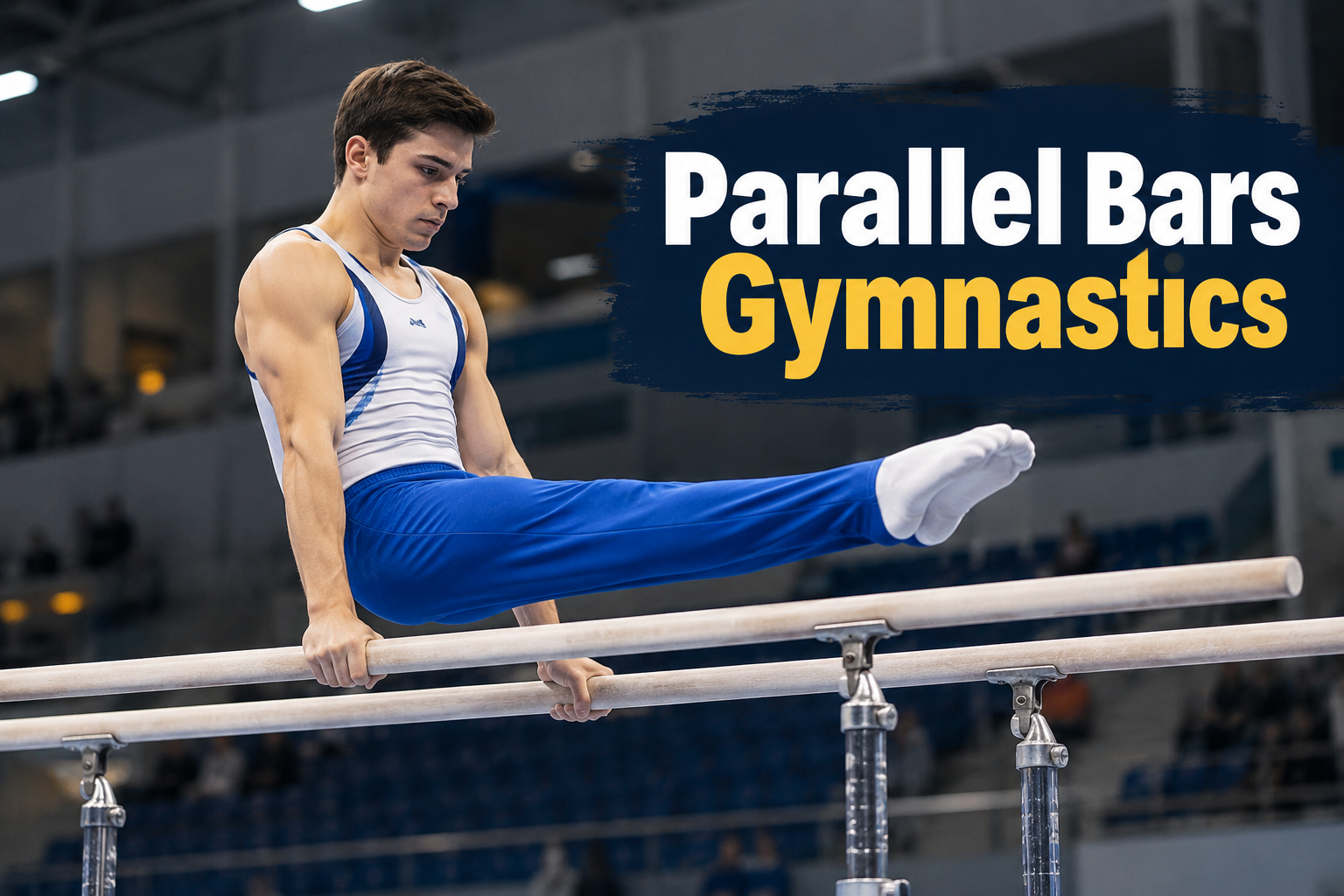
Parallel bars gymnastics is one of the most technical and impressive events in men’s artistic gymnastics. It combines strength, balance, timing, flexibility, coordination, and control. Gymnasts perform a complete routine while supporting or swinging their body between two horizontal bars placed parallel to each other.
At first glance, parallel bars may seem simpler than events such as the high bar or rings. However, performing advanced skills on parallel bars requires years of structured training. A gymnast must control the entire body while moving through swings, handstands, support positions, releases, turns, and a final dismount.
This guide explains what parallel bars gymnastics is, how the apparatus works, the main types of skills, scoring, training methods, safety, and the qualities needed to improve.
What Is Parallel Bars Gymnastics?
Parallel bars is an apparatus used mainly in men’s artistic gymnastics. The gymnast performs a routine on two long bars positioned side by side at the same height.
During a routine, the gymnast may swing below the bars, support the body above them, perform handstands, move from one end to the other, execute flight elements, and finish with a controlled dismount.
Unlike floor exercise, where the gymnast has a large surface to move across, parallel bars provide a narrow working area. This means accuracy is extremely important. Even a small mistake in hand placement or body position can affect the next skill.
The event rewards gymnasts who can make difficult movements appear smooth and controlled.
The Parallel Bars Apparatus
The parallel bars are designed to support dynamic gymnastics movements while remaining stable during a routine.
The apparatus consists of two strong horizontal rails supported by a metal frame. The distance between the rails can be adjusted within competition regulations so athletes can perform their routines comfortably and safely.
The bars themselves have some flexibility. They are not completely rigid. This controlled flexibility helps absorb force during swings, supports, and landings onto the bars.
Protective mats are placed around the apparatus to reduce the risk of injury during falls or dismounts.
Before performing, gymnasts often apply chalk to their hands. Chalk absorbs moisture and helps improve grip.
Why Parallel Bars Are Challenging
Parallel bars require several physical abilities at the same time.
A gymnast needs strong shoulders and arms to support body weight. Core strength is necessary to maintain straight body positions. Flexible shoulders and hips help the gymnast move through different shapes efficiently.
Balance is equally important, especially during handstands. The gymnast must place pressure correctly through the hands while making very small adjustments to stay balanced.
Timing becomes critical during swinging skills. If a gymnast changes body position too early or too late, the entire movement can lose height or control.
This combination of physical and technical demands makes parallel bars a challenging event to master.
Basic Positions on Parallel Bars
Before learning advanced skills, gymnasts develop strong basic positions.
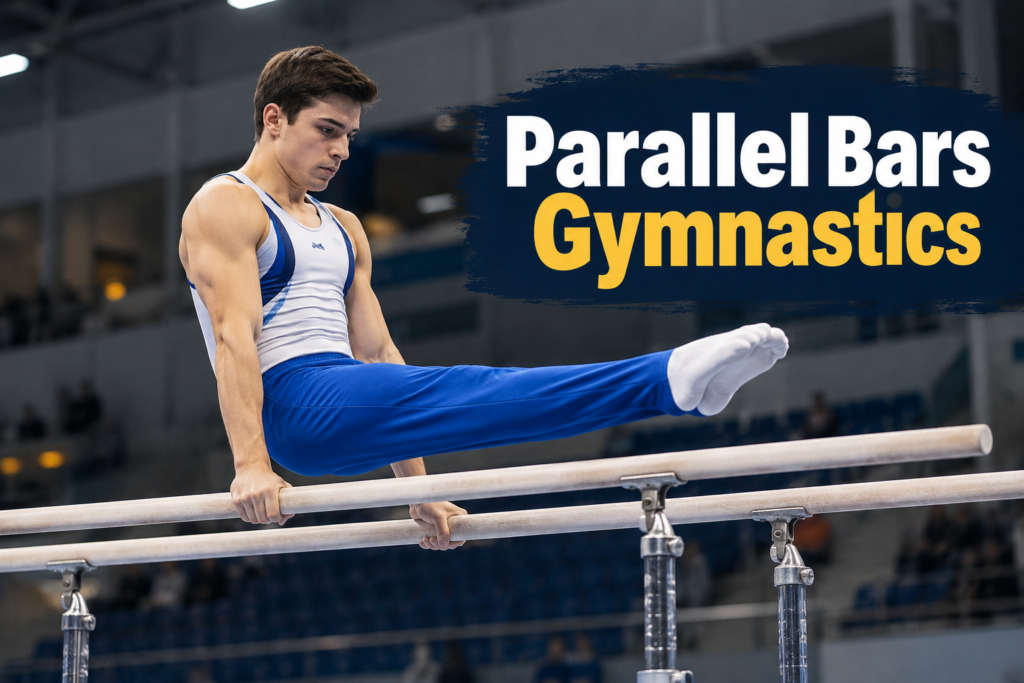
One of the most common is the support position. In this position, the gymnast holds the body above the bars with straight arms.
Another important position is the upper arm support, where the gymnast supports the body through the upper arms while the hands continue to hold the bars.
The hanging position is used when the gymnast swings below the bars.
Handstands are also essential. A well controlled handstand on parallel bars requires straight arms, tight body alignment, pointed toes, and strong balance.
Many advanced skills begin or end in one of these basic positions.
Swinging Skills
Swinging is a major part of parallel bars gymnastics.
Gymnasts learn how to generate momentum while keeping the body controlled. Effective swinging comes from coordinated movement through the shoulders, hips, and core rather than simply kicking the legs.
The body often moves between slightly arched and hollow shapes during the swing.
These changes in shape help create speed and height.
A strong swing can lead into a handstand, transition, release movement, or dismount. Because of this, gymnasts spend a significant amount of training time improving basic swing technique.
Poor swing mechanics can make advanced skills much more difficult.
Handstands on Parallel Bars
The handstand is one of the most important positions in artistic gymnastics.
On parallel bars, a gymnast performs the handstand while gripping two separate rails. Both arms should remain straight, and the shoulders should be extended fully.
The body ideally forms a straight line from the hands through the shoulders, hips, knees, and feet.
Good handstands demonstrate control and help connect different parts of the routine.
Judges may notice bent arms, separated legs, poor body alignment, or instability.
For this reason, gymnasts practice handstands frequently, both on the parallel bars and during general strength and balance training.
Strength Elements
Some parallel bar skills require the gymnast to hold the body in demanding positions.
Strength elements may involve supporting the body with straight arms while keeping the legs lifted or extended.
One familiar example is the L sit. In an L sit, the gymnast supports the body above the bars while holding both legs straight in front of the body.
More advanced strength positions require excellent shoulder stability, abdominal strength, and hip flexibility.
Although strength is important, gymnasts must also maintain clean technique. A difficult strength element performed with poor form can lead to execution deductions.
Flight Elements
Flight elements are among the most exciting movements in parallel bars gymnastics.
During these skills, the gymnast may release the bars temporarily before catching them again.
Flight elements require precise timing and awareness of body position.
The gymnast must generate enough height to complete the movement while maintaining control of rotation and direction.
Catching the bars securely is essential. Even a small error can cause the gymnast to miss the rails.
Because of the difficulty and risk involved, flight elements are usually introduced only after a gymnast develops strong fundamentals.
Turning and Pirouette Skills
Parallel bar routines can also include turns and pirouettes.
During these skills, the gymnast changes direction while supporting the body on the bars.
Some turns occur in a handstand, while others happen during swings or transitions.
These elements require strong balance because the gymnast may briefly place more weight on one hand while changing direction.
Good shoulder mobility makes turning movements smoother and more efficient.
Advanced routines often combine turns with swings or handstands to create flowing connections.
Transitions Between Positions
A successful parallel bars routine should not look like a collection of separate tricks.
Instead, the gymnast tries to connect skills naturally.
Transitions allow the gymnast to move from swinging below the bars to supporting above them, from support into handstand, or from one type of skill into another.
Smooth transitions are important because hesitation can interrupt the rhythm of the routine.
Judges look for confidence and continuous movement.
Gymnasts therefore practice connections repeatedly until they can move from one element to the next without unnecessary pauses.
The Parallel Bars Dismount
Every parallel bars routine ends with a dismount.
The gymnast generates enough momentum to leave the apparatus and perform a salto or twisting movement before landing on the mat.
A good dismount should show height, control, proper body shape, and a stable landing.
Landing with both feet together and minimal movement demonstrates control.
Steps, hops, deep body movement, or falls can lead to deductions.
Because the dismount is the final part of the routine, it can strongly influence the overall impression of the performance.
How Parallel Bars Routines Are Scored
In major artistic gymnastics competitions, routines are evaluated using separate measures for difficulty and execution.
Difficulty reflects the value of the skills performed and certain required elements within the routine.
Execution focuses on how well the routine is performed.
Judges may consider body alignment, bent arms, bent knees, leg separation, balance problems, pauses, poor landings, and other technical errors.
A gymnast may perform a very difficult routine, but mistakes can reduce the final result.
For this reason, successful gymnasts aim for a balance between difficulty and clean execution.
Common Mistakes in Parallel Bars
Beginners often make several predictable mistakes.
Bent arms during support positions are common because maintaining straight arms requires shoulder and triceps strength.
Another common issue is loss of body tension. When the core relaxes, the hips or legs may move out of alignment.
Gymnasts may also separate the legs unintentionally during swings or handstands.
Poor timing can reduce the height of swings and make transitions more difficult.
Another common problem is rushing into advanced skills before mastering basic techniques.
Consistent practice of fundamentals usually leads to better long term progress.
Strength Training for Parallel Bars
Strength training plays a major role in parallel bars preparation.
Gymnasts often develop strength through exercises such as push ups, dips, handstand holds, hollow body holds, leg raises, and support holds.
Core exercises are especially useful because nearly every parallel bars movement requires control of the trunk.
Shoulder stability exercises can also help athletes maintain strong positions.
However, strength should be developed progressively.
Gymnastics movements place significant stress on joints and muscles, so training should be appropriate for the athlete’s age, experience, and physical condition.
Flexibility and Mobility
Flexibility is another important part of parallel bars gymnastics.
Good shoulder mobility helps gymnasts move through swings and handstands efficiently.
Hamstring and hip flexibility can improve pike positions, L sits, and other skills involving straight legs.
Wrist mobility is also important because the hands support a large amount of body weight during training.
Stretching should be controlled and consistent rather than forced.
Many gymnastics programs combine mobility exercises with warm ups and conditioning.
Importance of Grip
The hands are the main connection between the gymnast and the apparatus.
A secure grip allows the athlete to control swings and maintain support positions.
Gymnasts often use chalk to reduce moisture on the hands.
Hand care is also important. Repeated training can cause calluses or skin irritation.
Athletes typically monitor the condition of their hands and follow the guidance of their coaches to avoid unnecessary problems.
Grip strength develops naturally through gymnastics training, although specific exercises may also be used.
Safety in Parallel Bars Training
Safety should always be a priority when practicing gymnastics.
Beginners should learn basic positions before attempting advanced release moves or difficult dismounts.
Qualified coaching is important because coaches can teach correct technique and provide spotting when needed.
Training areas should include suitable mats and properly maintained equipment.
Gymnasts should also warm up before intense training.
A warm up increases body temperature, prepares the joints, and helps athletes move more comfortably.
If a gymnast feels pain, continuing to train through it may make the problem worse. Proper recovery is an important part of long term athletic development.
Training Progression
Parallel bars skills are usually taught in stages.
A beginner may start with simple supports, swings, and basic holds.
Once these movements become stable, the gymnast can progress to handstands, more advanced swings, transitions, and dismount preparation.
Intermediate gymnasts begin connecting multiple elements into short sequences.
Advanced gymnasts focus on difficult combinations, flight elements, complex turns, and competition routines.
Progress is different for every athlete.
Gymnastics requires patience because even one skill may require hundreds or thousands of repetitions before it becomes reliable.
Benefits of Parallel Bars Gymnastics
Training on parallel bars develops many physical qualities.
It improves upper body strength, especially in the shoulders, chest, arms, and back.
It also develops core strength and body awareness.
Balance and coordination improve because gymnasts constantly adjust their position while moving.
Parallel bars training can also build discipline. Athletes must repeat skills regularly and pay attention to small technical details.
Confidence often grows as gymnasts gradually master movements that once seemed difficult.
Mental Skills in Parallel Bars
Mental focus is extremely important in gymnastics.
A gymnast must remember the complete routine while concentrating on technique.
There is very little time to think between elements, so movements must become familiar through repetition.
Confidence also affects performance.
Hesitation during a release or dismount can disturb timing.
Many gymnasts use mental rehearsal by imagining the routine before performing it.
Breathing and consistent preparation habits can also help athletes remain focused during competition.
Parallel Bars in Competitive Gymnastics
Parallel bars is one of the traditional apparatus events in men’s artistic gymnastics.
It appears in major national and international competitions, including world level events.
Elite routines include complex combinations of swinging skills, handstands, releases, transitions, turns, and difficult dismounts.
Although advanced routines look fast and effortless, they are built upon the same fundamental positions learned by beginners.
This shows why basic technique remains important even at the highest level of the sport.
Conclusion
Parallel bars gymnastics is a demanding discipline that combines strength, balance, flexibility, coordination, timing, and technical precision.
Gymnasts must learn how to support their body above the bars, swing efficiently, perform controlled handstands, connect difficult elements, and finish with a strong dismount.
Progress comes through consistent training and careful attention to basic technique. Athletes who develop strong fundamentals are better prepared to learn advanced skills safely and successfully.
Whether viewed at beginner level or in elite competition, parallel bars gymnastics demonstrates an impressive combination of athletic strength and precise body control. The best routines appear smooth and effortless, but behind every performance are countless hours of structured practice, conditioning, repetition, and technical improvement.