Gymnastics is a sport that develops strength, flexibility, balance, coordination, discipline, and confidence. For many beginners, however, understanding gymnastics levels can be confusing. Different programs may use different systems, and athletes often move through several stages before reaching advanced competition.
Gymnastics levels are designed to help athletes learn skills in a safe and organized way. Instead of attempting difficult movements too early, gymnasts build a strong foundation and gradually progress toward more challenging routines. Each level usually introduces new skills, combinations, strength requirements, and technical expectations.
This guide explains how gymnastics levels generally work, what gymnasts learn at different stages, and why proper progression is important.
What Are Gymnastics Levels?
Gymnastics levels are stages of development used to organize athletes according to their experience and skill. A beginner may start with simple body positions, rolls, jumps, and balance exercises. As the gymnast improves, more difficult skills are introduced.
The exact structure depends on the gymnastics organization, country, gym, and type of gymnastics. Artistic gymnastics, rhythmic gymnastics, trampoline gymnastics, and other disciplines can all have different progression systems.
In many artistic gymnastics programs, athletes move from introductory or recreational classes into structured competitive levels. Early levels focus on basic technique, while higher levels allow greater difficulty and more individual routine choices.
The purpose of a level system is not only competition. It also gives coaches a clear method for teaching skills in the correct order.
Beginner Gymnastics Levels
Most gymnasts begin in recreational classes rather than formal competition.
At this stage, the focus is on basic movement and body control. Children may learn how to jump, land, roll, hang, support their body weight, and move safely around gymnastics equipment.
Typical beginner skills may include:
Forward rolls
Backward rolls
Straight jumps
Tuck jumps
Basic handstands
Cartwheels
Bridge positions
Simple balances
Support holds on bars
Basic vaulting movements
These skills may appear simple, but they create the foundation for more advanced gymnastics.
A gymnast who develops strong basics usually finds future skills easier to learn. Poor technique at the beginner stage can become difficult to correct later, which is why coaches often spend a great deal of time teaching body position.
Pre Competitive Gymnastics
Some gymnastics clubs have a pre competitive stage between recreational classes and official competition.
Athletes in these programs begin training more seriously. They may practice several times each week and learn structured routines.
Training often focuses on:
Strength development
Flexibility
Body shaping
Handstands
Cartwheels
Round offs
Basic bar skills
Beam confidence
Vault preparation
Landing technique
Coaches also begin teaching athletes how competitions work.
Gymnasts learn how to present themselves, follow judges’ instructions, remember routines, and perform skills under pressure.
This stage helps determine whether an athlete is interested in competitive gymnastics.
Early Competitive Levels
Early competitive gymnastics introduces athletes to formal routines and judging.
The exact level names vary depending on the governing organization, but many programs use compulsory or standardized routines during the first competitive stages.
A compulsory routine means that gymnasts at the same level perform the same or very similar skills.
This system helps judges compare athletes based on execution rather than routine difficulty.
At these levels, gymnasts work on clean technique.
Coaches pay attention to details such as:
Pointed toes
Straight legs
Body alignment
Controlled landings
Arm positions
Rhythm
Balance
Confidence
Good execution becomes increasingly important as gymnasts progress.
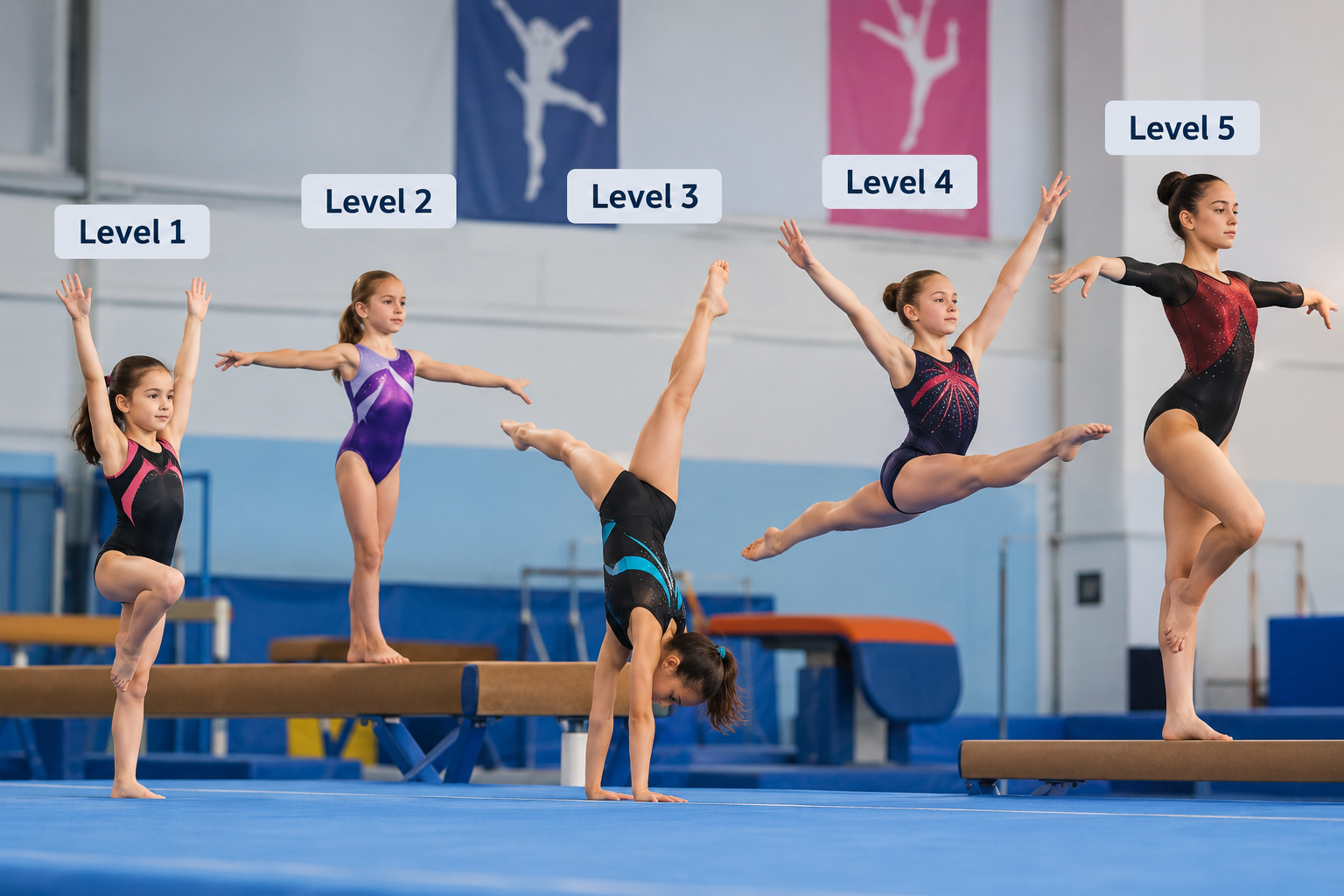
Level 1 Gymnastics
In some gymnastics systems, Level 1 represents one of the earliest stages of structured skill development.
It is often used as a developmental level rather than a major competitive level.
Gymnasts usually work on fundamental movements.
Floor exercises may include basic rolls, jumps, balances, and introductory handstand positions.
On bars, athletes may learn basic supports and swings.
Beam work may include walking, balancing, simple jumps, and controlled dismounts.
Vault training may focus on running, jumping from a springboard, and learning correct landing technique.
The main goal is body awareness and confidence.
Level 2 Gymnastics
Level 2 usually builds on the basic skills learned earlier.
Gymnasts may begin performing more complete skill combinations.
Floor work may include cartwheels, stronger handstands, bridges, and basic dance movements.
Beam exercises often become more demanding because athletes must perform skills on a narrow surface.
Bar training may introduce additional swings, casts, and basic transitions.
Vaulting may focus on stronger running technique and improved springboard use.
At this stage, coaches continue emphasizing control rather than difficulty.
Level 3 Gymnastics
Level 3 is often an important developmental stage.
Gymnasts begin combining basic skills into routines that require better strength, timing, flexibility, and confidence.
Floor routines may include skills such as round offs, handstand variations, and connected dance elements.
On bars, athletes may perform more complex combinations.
Beam routines may include jumps, turns, balances, and basic acrobatic skills.
Vaulting becomes more technical as gymnasts develop speed and power.
For many young athletes, this is also the stage where competition becomes more serious.
Level 4 Gymnastics
Level 4 usually represents a noticeable increase in difficulty.
Gymnasts need better strength and consistency because routines contain more demanding elements.
At this stage, athletes may practice stronger tumbling movements and more advanced bar skills.
Beam work can include additional leaps, turns, and acrobatic elements.
Vault training requires greater speed and body control.
Gymnasts must also become more consistent.
Performing a skill correctly once is not enough. Competitive athletes need to repeat their skills safely and accurately many times during practice.
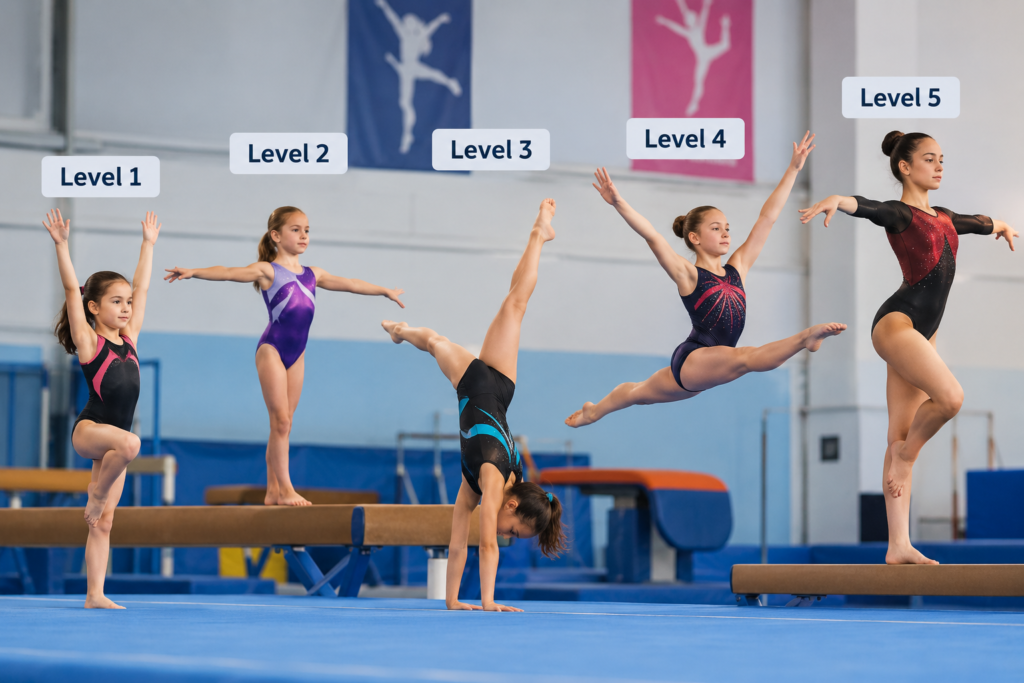
Level 5 Gymnastics
Level 5 typically continues the progression toward intermediate gymnastics.
Athletes may perform routines that combine several skills with limited pauses.
Floor exercises often require stronger tumbling, flexibility, dance presentation, and controlled landings.
Bars become particularly challenging because gymnasts must maintain momentum while moving through connected elements.
Beam requires confidence because small balance errors can result in major deductions or falls.
Vaulting also becomes faster and more powerful.
At this stage, physical conditioning becomes increasingly important.
Gymnasts often spend significant training time improving core strength, shoulder strength, leg power, and flexibility.
Intermediate Gymnastics Levels
Intermediate gymnastics is where athletes begin showing more advanced technique and independence.
Instead of simply learning basic compulsory routines, some programs allow gymnasts to perform more personalized combinations.
Training hours may also increase.
Intermediate athletes must develop:
Stronger tumbling
More complex bar transitions
Advanced beam combinations
Powerful vault techniques
Better flexibility
Improved endurance
Mental focus
Consistency
Gymnastics becomes increasingly demanding because athletes must combine difficulty with clean execution.
Level 6 Gymnastics
Level 6 is often considered a transition toward optional gymnastics in some competitive systems.
Optional gymnastics means athletes have more freedom to create routines that match certain requirements.
Instead of every gymnast performing exactly the same routine, coaches can select skills that suit the athlete’s strengths.
One gymnast may be particularly strong on bars, while another may excel on floor.
This flexibility allows routines to become more individual.
However, routines must still meet specific difficulty and composition requirements.
Level 7 Gymnastics
Level 7 generally introduces more advanced optional routines.
Gymnasts begin performing skills that require significant strength, flexibility, timing, and confidence.
Floor routines may contain advanced tumbling passes.
Beam routines may include more difficult acrobatic combinations.
Bars require stronger swings and transitions between elements.
Vaulting becomes more dynamic.
At this stage, athletes usually spend many hours training each week.
Progress depends not only on learning difficult skills but also on performing them consistently.
Level 8 Gymnastics
Level 8 represents advanced competitive gymnastics in many systems.
Athletes are expected to perform technically demanding routines.
Execution becomes extremely important because small mistakes can affect scores.
Gymnasts must demonstrate control while performing skills that involve speed, rotation, flight, and precise landings.
Training often includes detailed video review, strength conditioning, flexibility work, routine practice, and mental preparation.
Competition pressure can also increase at this level.
Athletes may attend larger regional or national events depending on the program.
Level 9 Gymnastics
Level 9 athletes are highly experienced.
Most have trained for several years and developed strong technical foundations.
Skills can include advanced tumbling, flight elements on bars, difficult beam combinations, and powerful vaults.
Coaches carefully plan routines so they satisfy competition requirements while matching the gymnast’s abilities.
Training becomes highly specialized.
A gymnast may spend weeks improving a single skill or connection.
At advanced levels, very small technical changes can improve performance.
Level 10 Gymnastics
Level 10 is one of the highest levels in many national gymnastics programs.
Athletes competing at this stage usually demonstrate exceptional strength, flexibility, coordination, and discipline.
Routines contain advanced optional skills and combinations.
Many Level 10 gymnasts have trained for a large part of their childhood or teenage years.
Some may later compete in university gymnastics, elite programs, or other high level competitions.
Reaching this level requires many years of consistent training.
Elite Gymnastics
Elite gymnastics is the highest competitive pathway in artistic gymnastics.
Elite gymnasts may compete nationally and internationally.
Some athletes aim for major international events such as continental championships, world championships, or the Olympic Games.
Elite gymnastics requires an extraordinary level of preparation.
Training may include several hours of gymnastics on many days each week.
Athletes work with coaches, medical professionals, strength specialists, and other support staff.
They must master very difficult skills while maintaining precise technique.
Only a small percentage of competitive gymnasts reach the elite level.
How Gymnasts Move to the Next Level
Moving to a higher level usually depends on several factors.
A gymnast may need to demonstrate required skills, achieve certain competition scores, meet age requirements, or receive approval from the coaching team.
Coaches also consider safety.
An athlete should not move up simply because they can perform one difficult skill.
They need sufficient strength, flexibility, confidence, consistency, and technical control.
Sometimes staying at the same level for another season can be beneficial because it allows the gymnast to strengthen weaknesses.
Progress in gymnastics is rarely identical for every athlete.
Why Gymnasts Progress at Different Speeds
Two gymnasts who start training together may progress very differently.
Several factors influence development.
Age can play a role, but it is not the only factor.
Natural flexibility, strength, coordination, training frequency, coaching quality, confidence, and injury history can all affect progress.
Some athletes learn tumbling quickly but struggle with bars.
Others may be excellent on beam but need more time to develop vault power.
This is normal.
Gymnastics requires many different physical and technical abilities.
The Importance of Strength and Flexibility
Higher gymnastics levels require significant physical preparation.
Gymnasts regularly work on core strength because the body must remain controlled during rotations, swings, handstands, and landings.
Shoulder strength is important for bars, handstands, and support positions.
Leg strength helps with jumping, vaulting, tumbling, and landing.
Flexibility is equally important.
Good shoulder, hip, back, and leg flexibility allows gymnasts to perform movements with better technique.
However, flexibility training should always be gradual and supervised.
Forcing stretches can increase the risk of injury.
Safety at Every Gymnastics Level
Safety is essential regardless of level.
Beginners and advanced athletes should learn difficult skills with proper coaching and equipment.
Gymnastics facilities commonly use mats, foam pits, spotting belts, padded equipment, and coach assistance during skill development.
Athletes should also be encouraged to communicate when they experience pain or feel uncomfortable attempting a movement.
Fatigue can affect coordination and increase injury risk.
Proper warm ups, conditioning, recovery, hydration, and sleep are therefore important parts of gymnastics training.
Competitive Scores and Levels
Moving through gymnastics levels is closely connected with scoring.
Judges evaluate routines based on factors such as difficulty, execution, artistry, composition, and required elements.
At beginner levels, routines may be more standardized.
At advanced levels, gymnasts can often increase difficulty by performing harder skills or more challenging combinations.
However, higher difficulty does not automatically guarantee a better score.
Poor execution can lead to deductions.
A clean routine with controlled technique may sometimes score better than a difficult routine with several mistakes.
Choosing the Right Gymnastics Level
The correct level should challenge a gymnast without placing them in an unsafe situation.
Parents and athletes should discuss progression with qualified coaches.
Important considerations include the gymnast’s skill level, physical preparation, confidence, training goals, and enjoyment.
Moving too quickly can create unnecessary pressure.
Moving carefully through each stage gives athletes time to develop strong technique.
Gymnastics is not a race.
Long term development is usually more important than reaching a particular level as quickly as possible.
Conclusion
Gymnastics levels provide a structured pathway from basic movement to advanced competition. Beginners start with simple skills such as rolls, jumps, balances, handstands, and cartwheels. As they progress, athletes develop more difficult tumbling, bar work, beam combinations, and vault techniques.
Intermediate and advanced levels require greater strength, flexibility, consistency, and technical control. Higher competitive stages allow gymnasts to perform more personalized and difficult routines, while elite gymnastics represents the highest level of the sport.
Every gymnast progresses differently, and reaching a new level should depend on readiness rather than speed. Strong fundamentals, qualified coaching, safe training, and consistent practice are the most important parts of long term improvement.
Understanding gymnastics levels can help athletes and parents appreciate how much development happens behind every routine. Whether a gymnast trains recreationally or dreams of advanced competition, each level provides new opportunities to learn, improve, and enjoy the sport.