Gymnastics has its own language. When beginners first start watching or practicing gymnastics, they may hear words such as vault, dismount, routine, tuck, layout, apparatus, deduction, and spotting. These terms can sound confusing at first, but understanding gymnastics terminology makes the sport much easier to follow.
Gymnastics terminology describes movements, equipment, body positions, competition rules, and training techniques. Some terms are used across several gymnastics disciplines, while others belong mainly to artistic, rhythmic, trampoline, or acrobatic gymnastics.
Learning these words is useful for gymnasts, parents, coaches, and anyone who enjoys watching competitions. This guide explains common gymnastics terminology in simple language so that beginners can build a strong understanding of the sport.
What Is Gymnastics Terminology?
Gymnastics terminology refers to the specialized words and expressions used to describe gymnastics skills, positions, equipment, judging, and training.
Instead of giving a long explanation every time an athlete performs a movement, coaches use specific terms. For example, a coach may tell a gymnast to perform a tuck jump instead of explaining that the gymnast should jump upward and bring the knees toward the chest.
This shared vocabulary helps athletes and coaches communicate clearly and efficiently.
Knowing gymnastics terms also helps spectators understand what is happening during a competition. Once you know what a dismount, landing, deduction, or connection means, routines become much easier to follow.
Apparatus
An apparatus is a piece of equipment used in gymnastics.
Different gymnastics disciplines use different apparatuses. In women’s artistic gymnastics, the main apparatuses are vault, uneven bars, balance beam, and floor exercise.
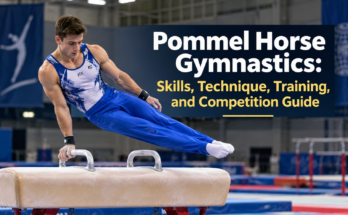
Men’s artistic gymnastics includes floor exercise, pommel horse, still rings, vault, parallel bars, and horizontal bar.
In rhythmic gymnastics, athletes may use a hoop, ball, clubs, ribbon, or rope depending on the competition format.
The word apparatus may refer to one piece of equipment or to an entire competitive event.
Routine
A routine is a planned sequence of gymnastics skills performed during training or competition.
A routine usually contains several movements connected together. These may include jumps, turns, balances, flips, swings, dance movements, and landings.
Competitive routines must normally meet specific requirements established by the rules of the competition.
Gymnasts practice routines repeatedly so they can perform the movements smoothly and confidently.
Skill
A skill is an individual gymnastics movement.
A cartwheel, handstand, back handspring, leap, or somersault can all be described as skills.
Gymnasts usually learn basic skills before progressing to more difficult ones. More advanced routines may combine many different skills into connected sequences.
Element
The word element is often used in competitive gymnastics to describe a recognized movement within a routine.
Many elements have specific difficulty values under gymnastics judging systems.
An element may involve strength, balance, flexibility, rotation, flight, or a combination of several physical abilities.
Mount
A mount is the movement a gymnast uses to begin performing on an apparatus.
For example, a gymnast may jump onto the balance beam using a particular mount.
Some mounts are simple, while advanced gymnasts may perform difficult acrobatic movements as part of their entrance onto the apparatus.
Dismount
A dismount is the final movement used to leave an apparatus.
Dismounts are especially important on events such as the balance beam, uneven bars, parallel bars, rings, and horizontal bar.
Advanced dismounts may include twists or somersaults before the gymnast lands on the mat.
A controlled landing can improve the overall impression of the routine.
Landing
A landing occurs when a gymnast returns to the floor or mat after completing a jump, flip, vault, or dismount.
Good landings require balance and body control.
Gymnasts are often encouraged to land with appropriate knee control and stable body positioning.
In competitions, unnecessary steps, hops, or falls after landing may result in deductions.
Stick
To stick a landing means to land without taking an extra step, hop, or noticeable movement.
A stuck landing is considered a sign of strong control.
You may often hear commentators say that a gymnast “stuck the landing” after completing a difficult routine.
Tuck Position
The tuck is one of the most common body positions in gymnastics.
In a tuck position, the gymnast brings the knees toward the chest while bending at the hips and knees.
This compact body shape allows the gymnast to rotate more quickly during certain flips and somersaults.
Tuck positions are commonly used by beginners and advanced gymnasts.
Pike Position
A pike position involves bending at the hips while keeping the legs relatively straight.
The upper body moves toward the legs while the knees remain extended.
Pike positions are used during jumps, flips, and many other gymnastics movements.
Maintaining straight legs and pointed toes helps make the position look clean and controlled.
Layout Position
A layout is a straight body position used during rotating or flying movements.
During a layout, the gymnast generally keeps the hips and knees extended rather than bending into a tuck or pike.
Layouts often require greater control and technique because the gymnast cannot rely on a compact body shape to rotate as quickly.
Straddle
A straddle position occurs when the legs are separated widely to each side.
Straddles appear in jumps, leaps, stretches, and several apparatus skills.
Flexibility is especially important when performing wide straddle positions.
Split
A split involves extending the legs in opposite directions.
Gymnasts frequently practice front splits and side splits as part of flexibility training.
Splits are also used during leaps, jumps, and dance movements.
Good flexibility can help gymnasts achieve cleaner positions and greater range of motion.
Handstand
A handstand is a fundamental gymnastics position in which the athlete supports the body on the hands while extending the body upward.
Handstands are important because many advanced gymnastics movements develop from handstand positions.
Gymnasts practice body alignment, shoulder strength, balance, and control while learning handstands.
Cartwheel
A cartwheel is a sideways movement in which the gymnast places the hands on the floor while the legs travel over the body.
It is often one of the first major skills learned by beginner gymnasts.
A well performed cartwheel usually shows straight legs, controlled hand placement, and smooth movement.
Roundoff
A roundoff is similar to a cartwheel but finishes with both feet landing together.
It is commonly used to generate power for other tumbling skills.
For example, a gymnast may perform a roundoff followed immediately by a back handspring.
Handspring
A handspring is an acrobatic movement in which the gymnast passes through a hand supported position while moving forward or backward.
A front handspring travels forward, while a back handspring travels backward.
Handsprings are important building blocks for more advanced tumbling combinations.
Somersault
A somersault is a movement in which the gymnast rotates forward or backward around the body’s horizontal axis.
Somersaults can be performed in tuck, pike, or layout positions.
They may be performed on the floor, from an apparatus, on a trampoline, or during a vault.
Salto
Salto is another term commonly used for a somersault performed in the air.
You may hear phrases such as front salto or back salto.
Multiple rotations can also be performed by advanced gymnasts.
Twist
A twist occurs when a gymnast rotates around the body’s vertical axis.
Twists can be added to flips, vaults, and dismounts.
Advanced gymnastics skills often combine both somersaulting and twisting movements.
Tumbling
Tumbling refers to acrobatic skills performed in sequence, usually across a gymnastics floor.
A tumbling pass may include roundoffs, handsprings, somersaults, and twists.
Tumbling requires speed, power, coordination, and precise technique.
It is an important part of artistic gymnastics and is also practiced as a separate gymnastics discipline.
Leap
A leap involves taking off from one foot and traveling through the air before landing.
Leaps are especially common in floor exercise, balance beam routines, and rhythmic gymnastics.
Many leaps involve split positions or other flexible body shapes.
Jump
A jump usually involves taking off from both feet and landing after performing a position or movement in the air.
Common examples include tuck jumps, straddle jumps, split jumps, and straight jumps.
Turn
A turn is a rotational movement performed while remaining in contact with the floor or apparatus.
Turns are common in floor exercise, balance beam, and rhythmic gymnastics.
Athletes may perform single, double, or multiple rotations depending on their ability and routine requirements.
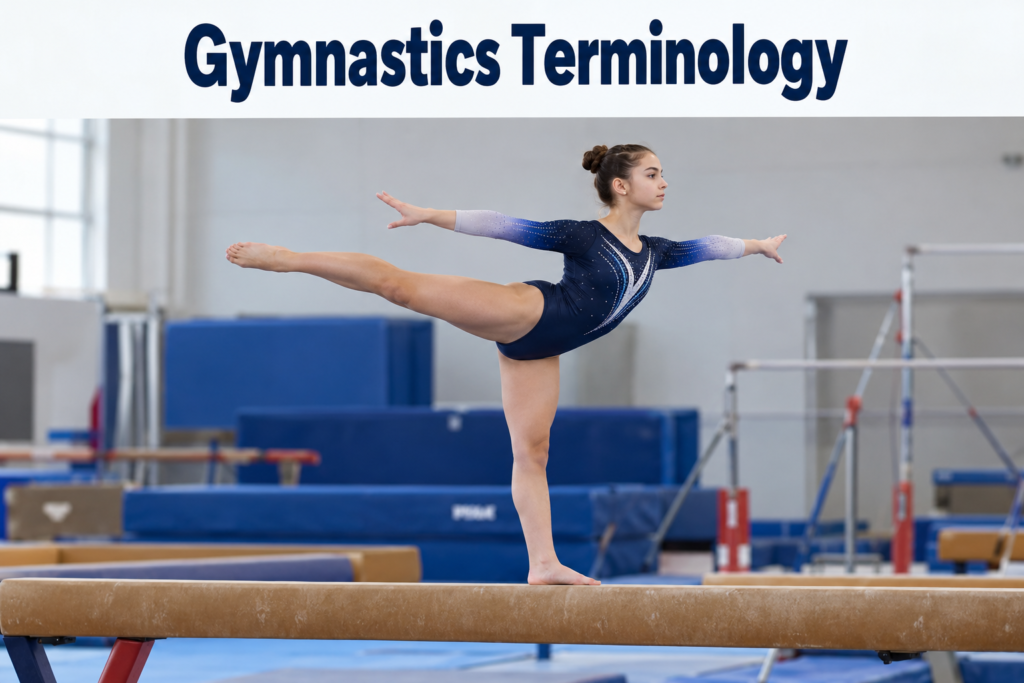
Balance
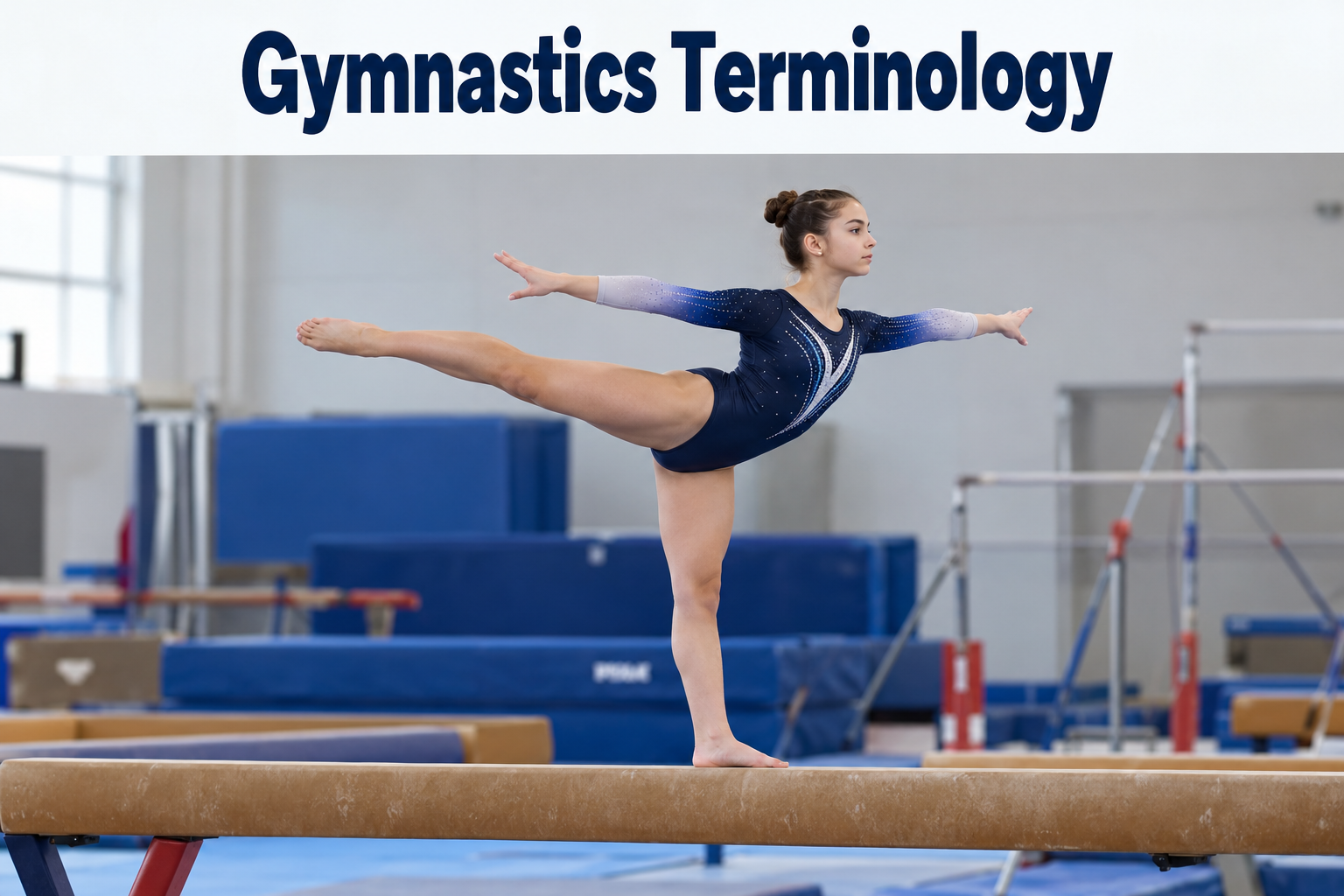
Balance refers to the ability to maintain a stable body position.
Gymnasts need excellent balance for many events, particularly the balance beam.
Balance skills may be performed while standing, kneeling, sitting, or supporting the body with different parts of the body.
Flexibility
Flexibility is the ability of the joints and muscles to move through a useful range of motion.
Gymnastics requires flexibility in areas such as the shoulders, hips, legs, and back.
Stretching is commonly included in gymnastics training to improve movement quality and help athletes perform specific skills.
Strength
Strength allows gymnasts to control their bodies during challenging movements.
Upper body strength is especially important on apparatuses such as rings, bars, and pommel horse.
Leg and core strength are also essential for jumping, landing, balancing, and tumbling.
Conditioning
Conditioning refers to physical exercises used to improve strength, endurance, power, flexibility, and overall fitness.
Gymnastics conditioning may include bodyweight exercises, core training, jumping drills, and flexibility work.
Strong physical conditioning helps athletes prepare for demanding skills.
Spotting
Spotting occurs when a coach assists or protects a gymnast while the gymnast practices a skill.
The coach may guide the gymnast’s body or remain nearby to reduce the risk of an uncontrolled fall.
Spotting is commonly used when athletes are learning new movements.
It should be performed by appropriately trained individuals.
Connection
A connection occurs when two or more gymnastics elements are performed one after another without unnecessary pauses.
Certain competitive routines may receive recognition for difficult combinations of connected skills.
Smooth connections can also make a routine appear more continuous and polished.
Combination
A combination is a sequence of skills performed together.
A tumbling combination, for example, might include a roundoff, back handspring, and back somersault.
Gymnasts gradually learn how to connect individual skills into longer combinations.
Execution
Execution refers to how well a gymnast performs a skill or routine.
Judges may consider factors such as body position, control, technique, landings, and precision.
Strong execution means the gymnast performs movements cleanly with minimal visible errors.
Difficulty
Difficulty describes the technical challenge of the skills included in a routine.
More complex skills generally receive greater difficulty recognition under competitive scoring systems.
Gymnasts must balance difficulty with execution because attempting very difficult movements can also increase the possibility of errors.
Deduction
A deduction is a reduction in a gymnast’s score because of an error or technical issue.
Possible deductions may result from falls, steps on landings, bent legs, poor body positions, or other mistakes depending on the competition rules.
Understanding deductions helps spectators understand why two routines containing similar skills may receive different scores.
Fall
A fall occurs when a gymnast loses control and comes off an apparatus or reaches the floor in an unintended way.
Falls usually lead to a significant deduction in competitive gymnastics.
Because of this, gymnasts train extensively to improve consistency and control.
Chalk
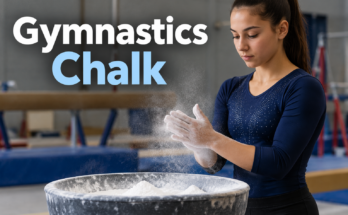
Gymnastics chalk is commonly used on the hands to improve grip and reduce moisture.
It is frequently used on apparatuses such as uneven bars, horizontal bar, rings, parallel bars, and pommel horse.
Chalk can help athletes maintain a more secure grip during difficult movements.
Grip
Grip describes how a gymnast holds an apparatus.
Different hand positions may be used depending on the event and skill.
The term may also refer to protective hand equipment worn by some gymnasts when performing on bars or rings.
Mat
A mat provides a cushioned surface for training and landing.
Different types and thicknesses of mats may be used depending on the gymnastics activity.
Training facilities often use additional mats while athletes learn new skills.
Spring Floor
A spring floor is the specialized floor surface used in artistic gymnastics.
It contains materials designed to provide controlled rebound.
This helps gymnasts generate power for tumbling while also providing a suitable surface for dance movements and landings.
Vault Table
The vault table is the apparatus used during the vault event.
Gymnasts sprint toward the apparatus, use a springboard, contact the table with their hands, and perform a flight movement before landing.
Vault requires speed, power, timing, and body control.
Springboard
A springboard is used to create additional upward or forward momentum.
It is commonly used during vault and may also be used for certain mounts.
Gymnasts must learn accurate foot placement and timing when using the springboard.
Code of Points
The Code of Points is the set of rules used to evaluate gymnastics competitions governed by specific gymnastics organizations.
It explains how skills are classified, how routines are evaluated, and what types of deductions may be applied.
Competitive gymnasts and coaches study the Code of Points when planning routines.
All Around
All around competition involves a gymnast competing across all the required apparatuses in that discipline.
In women’s artistic gymnastics, an all around gymnast competes on vault, uneven bars, balance beam, and floor exercise.
In men’s artistic gymnastics, all around competition includes six apparatuses.
Event Final
An event final is a competition focused on one specific apparatus.
Gymnasts may qualify for event finals based on earlier performances under the rules of the competition.
These finals allow specialists on individual apparatuses to compete for event medals or rankings.
Warm Up
A warm up prepares the body for physical activity.
Gymnastics warm ups often include light movement, mobility exercises, stretching, and basic skill preparation.
A suitable warm up helps athletes prepare their muscles and joints for training.
Cool Down
A cool down occurs after training or competition.
It may involve gentle movement and stretching while the body gradually returns to a resting state.
Many athletes use cool downs as part of their regular training routine.
Why Gymnastics Terminology Is Important
Learning gymnastics terminology makes both training and watching the sport easier.
Gymnasts can understand instructions more quickly when they recognize standard terms. Parents can follow what coaches are teaching, and spectators can better understand commentary during competitions.
The terminology also creates a common language between athletes and coaches from different gyms and countries.
A beginner does not need to memorize every gymnastics term immediately. Learning the basic vocabulary gradually is usually more effective. As athletes become more experienced, they naturally encounter more advanced terminology.
Conclusion
Gymnastics terminology covers nearly every part of the sport, including body positions, skills, equipment, training techniques, and competition rules. Basic terms such as tuck, pike, layout, handstand, dismount, landing, routine, and deduction provide a foundation for understanding gymnastics.
Learning these terms can make training more understandable and competitions much more interesting to watch. Beginners can start with simple vocabulary and gradually learn more advanced terms as their knowledge grows.
Whether you are a gymnast, parent, coach, or fan, understanding gymnastics terminology gives you a clearer picture of how this technical and highly skilled sport works.