Gymnastics is one of the most exciting sports to watch, but understanding how gymnasts receive their scores can sometimes be confusing. A routine may look nearly perfect to an ordinary viewer, yet the gymnast may receive a lower score than expected. Another gymnast might make a small visible mistake and still finish with a higher total.
The reason is that modern gymnastics scoring considers much more than whether a gymnast stays on the apparatus or completes a routine without falling. Judges evaluate difficulty, technique, body position, landings, control, and many other details.
Once the basic scoring system is understood, watching gymnastics becomes much more interesting. You can begin to recognize why certain skills earn more points, why deductions are taken, and how gymnasts increase the value of their routines.
What Is Gymnastics Scoring?
Gymnastics scoring is the system judges use to evaluate a gymnast’s performance during competition.
In major international competitions, scoring rules are established through the Code of Points published by the International Gymnastics Federation, commonly known as FIG or World Gymnastics.
Different gymnastics disciplines have their own scoring requirements. Artistic gymnastics, rhythmic gymnastics, trampoline gymnastics, acrobatic gymnastics, and aerobic gymnastics are not scored in exactly the same way.
However, one important idea appears throughout modern gymnastics.
Judges usually evaluate both what the gymnast performs and how well the gymnast performs it.
In artistic gymnastics, these ideas are commonly represented by the Difficulty Score and Execution Score.
The Difficulty Score
The Difficulty Score is often called the D Score.
It represents the difficulty and content of the gymnast’s routine.
Unlike the old scoring system, the Difficulty Score does not normally have a fixed maximum of 10 points in elite artistic gymnastics. A gymnast can potentially increase the score by performing more difficult skills and valuable combinations, provided the routine follows the required rules.
Every recognized gymnastics skill has an assigned difficulty value.
A simple element may be worth relatively little, while an advanced twisting or flipping skill can contribute much more to the routine’s difficulty.
Judges look at the skills that are successfully completed and calculate the appropriate difficulty value according to the Code of Points.
This means that two gymnasts performing on the same apparatus may begin with very different levels of difficulty.
One gymnast might attempt a safer routine with fewer difficult elements, while another may attempt a highly demanding routine that provides greater scoring potential.
However, difficulty alone does not guarantee victory.
The Execution Score
The Execution Score is often called the E Score.
Execution judges evaluate how correctly and cleanly the gymnast performs the routine.
In artistic gymnastics, execution generally begins from a maximum score of 10.0. Judges then subtract points for mistakes.
A gymnast with excellent form and very few errors may keep most of those 10 points. A gymnast who makes several technical mistakes can lose a significant amount.
Execution judges pay attention to details such as body alignment, leg position, pointed toes, balance, control, technique, amplitude, and landings.
The basic idea is simple.
A gymnast wants to perform difficult skills while making them look controlled and technically correct.
How the Final Score Is Calculated
In elite artistic gymnastics, the basic calculation is generally:
Difficulty Score + Execution Score = Final Score
Additional penalties may then be applied when necessary.
For example, imagine a gymnast earns a Difficulty Score of 5.8 and an Execution Score of 8.4.
The total would be:
5.8 + 8.4 = 14.2
If there were no additional penalties, the gymnast’s final score would be 14.200.
A second gymnast could have a higher Difficulty Score of 6.2 but an Execution Score of only 7.7.
The result would be:
6.2 + 7.7 = 13.9
Even though the second gymnast attempted a more difficult routine, the first gymnast would receive the higher score because of better execution.
This balance between difficulty and quality is one of the most interesting parts of gymnastics competition.
Common Gymnastics Deductions
Gymnastics judges can deduct points for many different errors.
Some mistakes are obvious to spectators, while others require trained judges to recognize.
One of the most common deductions is for bent legs when the skill requires straight legs.
Judges can also deduct points for separated legs, flexed feet, poor body position, lack of height, insufficient rotation, balance problems, and uncontrolled movement.
Landing errors are particularly noticeable.
A gymnast may lose points for taking a small step after landing, making a larger step, hopping, touching the floor, or falling.
Falls usually result in significant deductions compared with small technical errors.
Judges also consider whether movements appear controlled rather than forced or unstable.
Why Pointed Toes Matter
People new to gymnastics sometimes wonder why judges care so much about pointed toes.
Pointed toes are part of proper gymnastics form.
During many skills, gymnasts are expected to create long, clean body lines. Flexed feet can make an otherwise impressive skill look less precise.
Although a single form error may appear small, repeated mistakes throughout a routine can gradually reduce the Execution Score.
The same principle applies to bent knees, separated legs, or poor arm positions.
Elite gymnastics rewards attention to detail.
Landing Deductions
Landings are one of the most important parts of gymnastics scoring.
Ideally, a gymnast wants to finish a tumbling pass, vault, dismount, or other major skill with excellent control.
A completely controlled landing without unnecessary foot movement is often called a stuck landing.
Gymnasts try to achieve stuck landings because movements after landing can result in deductions.
A small adjustment may cause a minor deduction, while a large step or jump may cost more.
A fall can have a major effect on the final score.
Landing quality can therefore determine the outcome of very close competitions.
Two gymnasts may perform routines with similar difficulty, but the gymnast who controls the landings more effectively may receive the higher total.
Connection Value
Gymnasts can sometimes increase their Difficulty Score by connecting certain skills directly together.
This is known as connection value.
Instead of performing two difficult elements separately, the gymnast performs them consecutively without unnecessary pauses.
If the connection meets the requirements in the Code of Points, additional difficulty credit may be awarded.
Connections are common on apparatus such as uneven bars, balance beam, and floor exercise.
They allow gymnasts to increase routine difficulty without necessarily adding many completely separate skills.
However, connections also increase risk.
If a gymnast hesitates or breaks the connection, some or all of the expected connection value may be lost.
Composition Requirements
A gymnast cannot simply perform any collection of difficult skills.
Routines must usually contain specific categories of elements.
These are often known as composition requirements.
For example, a routine might require gymnasts to demonstrate certain types of movements, turns, flight elements, acrobatic skills, or transitions.
Meeting these requirements contributes to the Difficulty Score.
If an important requirement is missing, the gymnast may lose valuable difficulty credit.
Coaches therefore design routines carefully.
The goal is to include required elements, valuable skills, useful connections, and movements the gymnast can perform consistently.
Vault Scoring
Vault is somewhat different from other artistic gymnastics events because gymnasts perform a single vault rather than a long routine made from many individual skills.
Each recognized vault has an assigned difficulty value.
The gymnast’s score depends on the difficulty of the selected vault and the quality of its execution.
Judges examine the gymnast’s technique throughout the vault.
They may consider body position, height, distance, rotation, direction, and landing control.
A difficult vault can create strong scoring potential, but poor execution can quickly reduce the total.
Landing is especially important because even a technically strong vault can lose points through large steps or a fall.
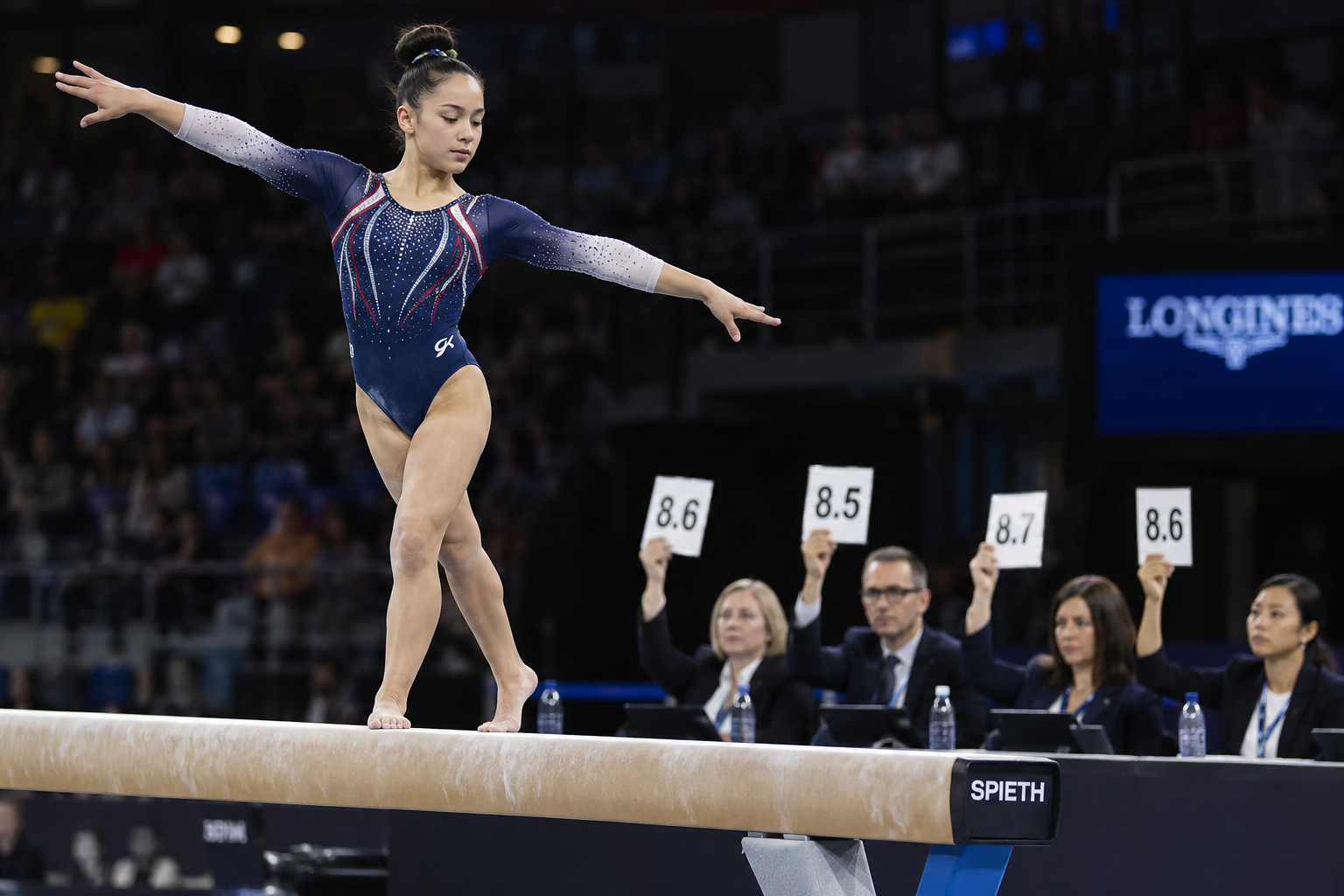
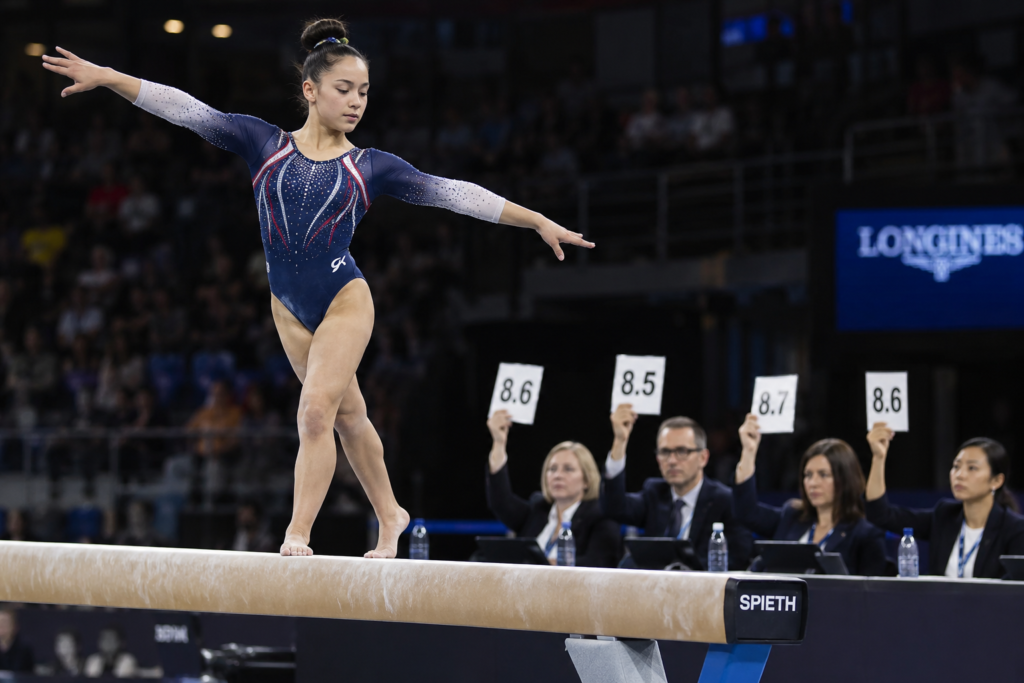
Balance Beam Scoring
Balance beam requires gymnasts to combine acrobatics, leaps, turns, dance movements, and connections on an apparatus only 10 centimeters wide.
Judges evaluate both difficulty and execution.
Balance errors are particularly important.
A gymnast who waves the arms, bends the body, pauses excessively, grabs the beam, or falls may receive deductions depending on the mistake.
Rhythm also matters.
A strong beam routine should appear confident and continuous rather than hesitant.
This is why experienced gymnasts try to make extremely difficult movements look calm and natural.
Uneven Bars and Horizontal Bar
On uneven bars and horizontal bar, judges evaluate elements such as releases, transitions, turns, swings, flight skills, and dismounts.
Gymnasts can increase difficulty by performing valuable skills and connecting them.
Execution remains equally important.
Bent arms, leg separation, poor body position, unsuccessful handstands, and uncontrolled landings can all affect the score.
The best routines combine spectacular difficulty with smooth movement.
Floor Exercise Scoring
Floor exercise combines tumbling skills with other required movements.
Women’s artistic floor routines also include choreography and dance components performed to music, while men’s floor exercise has different composition requirements.
Judges evaluate difficult acrobatic elements, connections, landings, technique, and overall execution.
A powerful tumbling pass may receive strong difficulty credit, but steps on landing or poor body form can reduce the Execution Score.
Athletes must therefore combine power with precision.
Rhythmic Gymnastics Scoring
Rhythmic gymnastics uses a different scoring structure from artistic gymnastics.
The current FIG system separately evaluates areas such as difficulty, artistry, and execution.
Gymnasts perform routines using apparatus such as hoop, ball, clubs, and ribbon.
Execution judges evaluate technical accuracy and deduct for visible errors. Under the current FIG rhythmic Code of Points, execution deductions are classified according to the severity of the mistake, with small, medium, and larger errors receiving progressively greater deductions.
Difficulty includes body difficulties and apparatus related elements, while artistry considers how the routine is constructed and performed.
Because rhythmic gymnastics combines physical difficulty, apparatus handling, music, and artistic presentation, its judging system is highly detailed.
Why Gymnastics No Longer Uses Only the Perfect 10
Many people still associate gymnastics with the famous “perfect 10.”
For decades, the 10.0 score was one of the sport’s most recognizable traditions.
Modern elite artistic gymnastics uses an open ended scoring approach instead.
Separating difficulty from execution allows judges to recognize increasingly difficult routines while still rewarding excellent technique.
A gymnast can increase scoring potential by raising the Difficulty Score, but there is always a tradeoff.
Higher difficulty often increases the chance of mistakes.
As a result, athletes and coaches must decide which skills provide the best combination of difficulty and consistency.
Why Two Similar Routines Can Receive Different Scores
To an ordinary viewer, two routines may appear almost identical.
Judges, however, examine extremely small details.
One gymnast may have slightly bent knees during several skills.
Another may fail to reach the correct body position.
Someone else may take small steps on multiple landings.
These deductions can accumulate.
The difference between first and second place can sometimes be only a few tenths or even hundredths of a point.
That is why small technical details matter so much at high level competitions.
The Role of Gymnastics Judges
Gymnastics competitions use several judges because a single person would have difficulty evaluating every aspect of a complex routine accurately.
Different members of the judging panel may have different responsibilities.
Some evaluate difficulty.
Others focus on execution.
Additional officials may deal with matters such as timing, line violations, or other specific penalties.
The exact judging structure depends on the gymnastics discipline and competition.
Judges undergo extensive training to learn the Code of Points and identify skills correctly.
World Gymnastics publishes separate Codes of Points and judging materials for different disciplines, including artistic, rhythmic, trampoline, acrobatic, and aerobic gymnastics.
Why Gymnastics Scoring Changes
Gymnastics scoring rules are updated periodically.
The sport continues to develop as athletes introduce new skills, combinations, and training techniques.
Rules may be adjusted to encourage particular types of gymnastics, improve safety, clarify judging, or maintain balance between difficulty and execution.
This is why scoring rules from an older Olympic cycle may differ from current rules.
Gymnasts, coaches, and judges must therefore stay familiar with the latest Code of Points.
Final Thoughts
Gymnastics scoring becomes much easier to understand once you recognize the relationship between difficulty and execution.
Gymnasts are not simply trying to perform the hardest routines possible. They are trying to find the right balance between difficult skills and clean performance.
A routine with enormous difficulty can lose its advantage through falls, poor landings, or technical mistakes. At the same time, a perfectly clean routine may struggle to achieve the highest totals if its difficulty is too low.
That balance makes gymnastics fascinating.
Every pointed toe, landing, connection, turn, swing, and body position can affect the final result.
The next time you watch a gymnastics competition, pay attention not only to the spectacular flips and twists but also to the smaller details. Watch the landings, body positions, pauses, balance corrections, and connections between skills.
Understanding these details makes it much easier to see why judges award particular scores and gives you a deeper appreciation for the extraordinary precision required in competitive gymnastics.