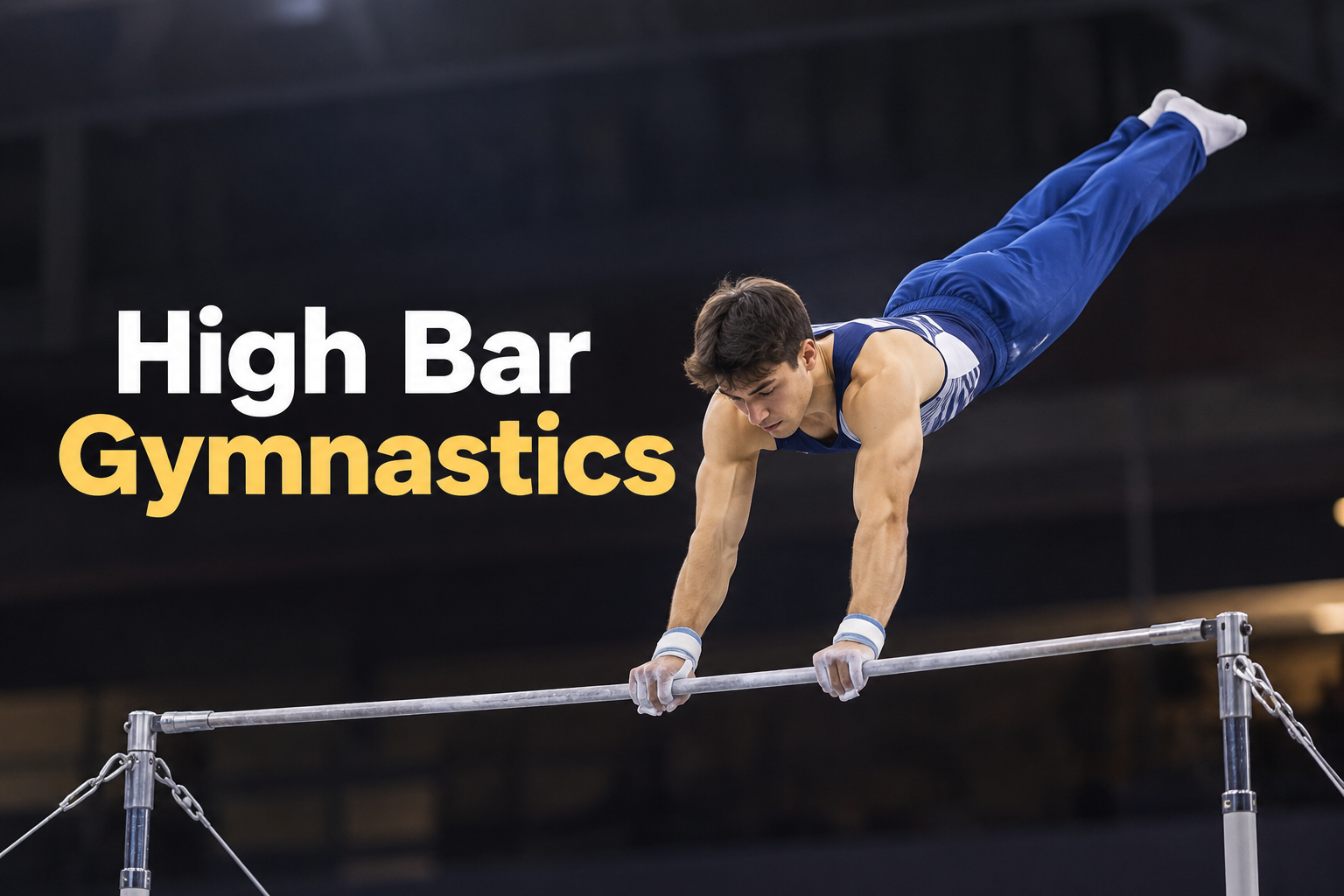
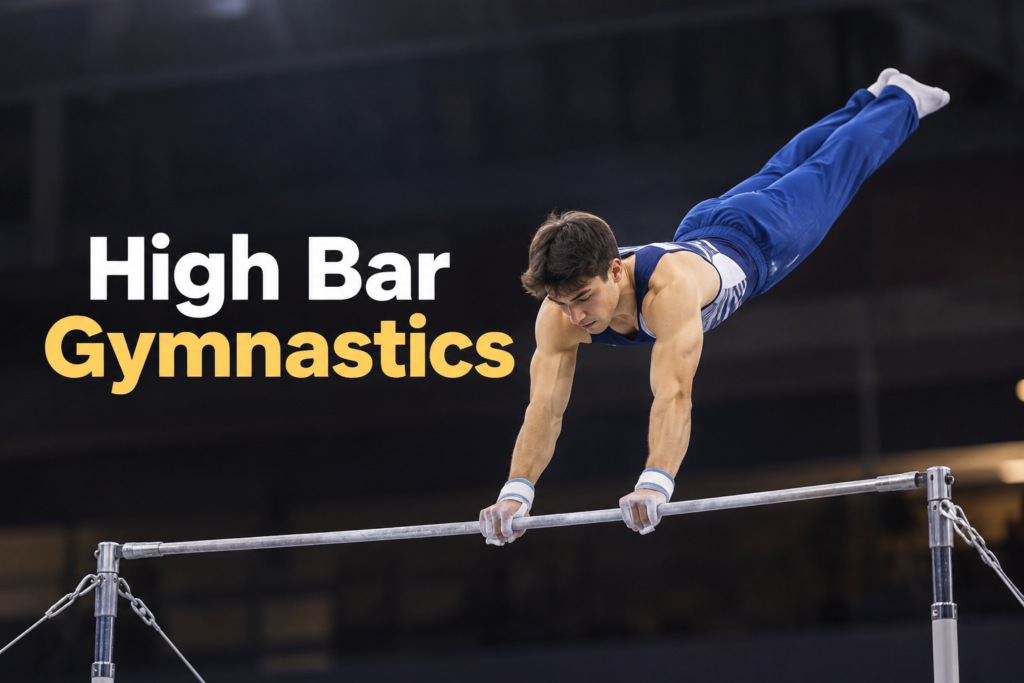
High bar gymnastics is one of the most exciting events in men’s artistic gymnastics. It combines strength, speed, coordination, courage, and precise timing. During a high bar routine, a gymnast swings around a single horizontal bar while performing releases, turns, changes of direction, and a controlled dismount.
What makes high bar gymnastics especially impressive is the continuous movement. Unlike some events where athletes can briefly pause or hold a position, high bar routines depend heavily on momentum. Gymnasts must maintain rhythm while moving from one skill to the next.
For beginners, the event can look simple because the equipment consists mainly of one bar. In reality, high bar requires years of structured training. Even basic skills demand strong shoulders, reliable grip strength, good body control, and an understanding of how swinging movement works.
This guide explains high bar gymnastics, the equipment used, common skills, training methods, scoring basics, safety, and what gymnasts need to improve their performance.
What Is High Bar Gymnastics?
High bar gymnastics is a men’s artistic gymnastics apparatus event. It is also commonly known as the horizontal bar.
The gymnast performs a routine on a raised metal bar. The routine normally contains large swings, changes in grip, turns, flight skills, and a dismount.
The goal is not simply to perform difficult movements. A successful routine should also look smooth and controlled. Gymnasts try to connect skills naturally while maintaining body tension and consistent rhythm.
High bar routines are often among the most dramatic performances in a gymnastics competition because release moves can send athletes high above the bar before they catch it again.
The High Bar Apparatus
The high bar consists of a strong horizontal metal bar supported by upright structures.
The apparatus is designed to handle significant forces created by swinging athletes. During giant swings and release moves, the gymnast can generate considerable speed and pressure.
The bar has some flexibility, allowing it to respond slightly to the athlete’s movement. This helps gymnasts maintain rhythm while performing powerful swings.
Protective mats are placed underneath and around the apparatus. These mats help reduce the risk of injury if a gymnast falls.
Athletes also commonly use grips on their hands. Gymnastics grips are usually made from leather and are designed to improve security when holding the bar.
Chalk is frequently used as well. It helps absorb moisture and may improve grip during training and competition.
Why High Bar Gymnastics Is Difficult
High bar gymnastics requires several physical abilities at the same time.
A gymnast must have strong shoulders and arms, but upper body strength alone is not enough. The athlete also needs excellent core control, flexibility, timing, balance, coordination, and grip endurance.
Momentum plays a major role.
If a gymnast swings too slowly, there may not be enough energy to complete the next skill. If the swing becomes too fast or the release timing is incorrect, control can be lost.
The gymnast therefore has to understand exactly when to open, close, turn, release, or regrip.
Many difficult skills happen within fractions of a second.
Basic High Bar Skills
Before learning advanced release movements, gymnasts spend significant time developing fundamental skills.
One of the first skills is simply hanging correctly from the bar.
A proper hang helps athletes understand shoulder position, grip, and body alignment.
Gymnasts then learn different swinging movements. Small swings gradually develop into larger swings as confidence and technique improve.
Another important basic skill is the pullover. This movement allows the gymnast to move from below the bar to a supported position above it.
Cast movements may also be practiced because they help gymnasts understand body extension and balance.
These basic exercises create the foundation needed for more advanced high bar gymnastics.
Giant Swings
The giant swing is one of the most recognizable high bar skills.
During a giant swing, the gymnast rotates completely around the bar with the body extended.
Although it may look like a simple circular movement, a good giant requires careful technique.
The athlete must maintain body tension while using the shoulders, hips, and core to control speed.
Giant swings are especially important because they generate momentum for many advanced elements.
A gymnast may perform several giants before attempting a release move or dismount.
Training a consistent giant swing is therefore a major part of high bar development.
Grip Changes
Gymnasts use different grips depending on the skill being performed.
An overhand grip is common, but athletes may also use an underhand or mixed grip.
Changing grip while swinging requires accuracy.
The gymnast may need to release one or both hands briefly before catching the bar again in a different position.
Good grip technique allows the athlete to move smoothly through the routine without interrupting momentum.
Coaches normally introduce grip changes gradually so athletes can become comfortable with different hand positions.
Release Moves
Release moves are among the most spectacular parts of high bar gymnastics.
During a release skill, the gymnast intentionally lets go of the bar while moving through the air.
The athlete may perform a flip, turn, or other movement before catching the bar again.
These skills require precise timing.
Releasing too early or too late can dramatically affect the gymnast’s flight path.
The athlete must also locate the bar while moving through the air and prepare the hands for the catch.
Release skills are usually practiced using safety equipment and experienced coaching supervision.
Gymnasts often spend many training sessions repeating drills before performing a full release move independently.
Turns and Pirouettes
Turns help add variety and difficulty to a high bar routine.
A gymnast may rotate around one arm or change direction while swinging.
These skills require strong shoulder control and accurate hand placement.
Because high bar routines depend on continuous motion, a turn must usually connect naturally into the following movement.
Poor timing may reduce swing speed or affect the gymnast’s position for the next skill.
Experienced gymnasts make turns appear effortless, but developing that level of control requires repeated practice.
High Bar Dismounts
Every high bar routine ends with a dismount.
The gymnast releases the bar and performs a movement in the air before landing on the mat.
Dismounts can include flips, twists, or combinations of both.
The athlete needs sufficient height and rotation to complete the skill safely.
Landing is also important.
A controlled landing demonstrates that the gymnast maintained awareness and body control throughout the movement.
Gymnasts try to land upright with good balance and minimal unnecessary movement.
Advanced dismounts can be extremely difficult because athletes leave the bar with substantial speed.
Strength Needed for High Bar
High bar gymnastics develops and requires strong upper body muscles.
The shoulders play an especially important role because they absorb and control forces during swinging.
The back, arms, forearms, chest, and core are also heavily involved.
Grip strength is essential.
Gymnasts may spend an entire routine holding the bar while swinging rapidly through different positions.
However, good high bar technique does not depend on squeezing the bar as hard as possible at all times.
Athletes learn how to maintain a secure grip while allowing their hands and wrists to adjust naturally during swings.
Core strength is equally important because it helps maintain straight body lines and control rotation.
Flexibility and Mobility
Shoulder flexibility is particularly important in high bar gymnastics.
During certain swinging positions, the shoulders move through a large range of motion.
Athletes also benefit from flexibility in the hips, back, and legs.
Good flexibility helps gymnasts achieve clean shapes and may make technical movements easier to perform.
Flexibility training should be gradual and controlled.
Gymnasts commonly combine stretching with strength exercises so joints remain both mobile and stable.
Training for High Bar Gymnastics
High bar training usually begins with basic body control exercises.
Gymnasts may practice hanging, swinging, hollow body positions, arch positions, pullups, core exercises, and grip training.
As technique improves, larger swings and more complicated elements are introduced.
Coaches frequently break advanced skills into smaller drills.
For example, a gymnast learning a release move might first practice the body position on another apparatus or with spotting assistance.
Safety equipment such as foam pits, harness systems, spotting belts, and thick landing mats may also be used.
Progressive training allows gymnasts to develop confidence without rushing difficult skills.
Importance of Timing
Timing is one of the most important abilities in high bar gymnastics.
Many skills depend more on correct timing than pure strength.
A gymnast needs to understand how the body interacts with the movement of the bar.
For example, opening the hips at the correct moment can increase swing speed.
Changing body position too early or too late may reduce momentum.
Experienced gymnasts develop a strong sense of rhythm.
They can feel how much energy is available during a swing and adjust their movements accordingly.
High Bar Competition Routines
Competitive high bar routines contain a combination of skills that demonstrate difficulty, variety, and execution.
Gymnasts typically try to include different types of elements rather than repeating the same movement.
A routine may include giant swings, grip changes, turns, release skills, and a difficult dismount.
The exact routine depends on the athlete’s ability and competition level.
Elite gymnasts often choose skills that provide high difficulty while still allowing them to perform consistently.
A routine that contains extremely difficult skills is not automatically successful. Errors can significantly affect the final score.
How High Bar Gymnastics Is Scored
At higher levels of artistic gymnastics, scoring generally considers both difficulty and execution.
Difficulty reflects the value and combination of skills performed in the routine.
Execution focuses on how accurately those skills are performed.
Judges may consider body position, technique, control, rhythm, catches, and the landing.
Mistakes can lead to deductions.
Examples may include bent arms or legs, poor body alignment, extra movements, missed catches, or landing errors.
Falling from the apparatus can result in a substantial deduction.
Because of this, gymnasts try to balance difficulty with consistency.
Common High Bar Mistakes
One common mistake is losing body tension during swings.
If the gymnast bends or relaxes at the wrong moment, momentum and control may decrease.
Another common issue is incorrect release timing.
Even a small timing error may make catching the bar difficult.
Grip problems can also affect performance.
If the hands are incorrectly positioned, the athlete may struggle to maintain control during turns or swings.
Landing mistakes are another important concern.
Taking several steps after a dismount may affect execution.
Good coaching and repeated technical practice help gymnasts reduce these errors.
Safety in High Bar Gymnastics
High bar gymnastics should always be practiced in a properly equipped gymnastics facility.
Beginners should not attempt advanced skills without qualified instruction.
Coaches normally teach athletes gradually and use appropriate spotting methods when necessary.
Proper warmups are also important.
Gymnasts usually prepare the shoulders, wrists, elbows, back, core, and legs before beginning high intensity training.
Equipment should be inspected regularly.
The bar, supports, grips, mats, and surrounding training area should remain in good condition.
Athletes should also communicate with coaches if they experience pain, unusual discomfort, or problems with equipment.
High Bar Gymnastics for Beginners
Beginners should focus on fundamentals instead of difficult tricks.
Learning how to hang, swing, maintain body tension, and control basic positions creates a strong technical base.
Grip strength will normally improve gradually with regular training.
Beginners can also practice basic conditioning exercises that support gymnastics development.
These may include pullups, hanging exercises, core training, flexibility work, and controlled body position drills.
Progress in gymnastics often takes time.
Repeated practice allows athletes to become more comfortable with the apparatus and understand how their body moves during swings.
Mental Confidence
High bar gymnastics also requires mental confidence.
Release moves and dismounts can take athletes several meters above the floor.
Even when protective mats are available, gymnasts must trust their technique.
Confidence normally develops through preparation rather than simply ignoring fear.
Athletes practice drills repeatedly until the movements become familiar.
Coaches may also use progressions that allow gymnasts to experience parts of a skill safely before attempting the complete movement.
Mental preparation becomes especially important during competition, when athletes must perform their routine under pressure.
Benefits of High Bar Gymnastics
High bar training develops several useful physical abilities.
It improves grip strength, shoulder stability, coordination, core strength, flexibility, and body awareness.
Gymnastics also teaches discipline.
Difficult skills may require hundreds or even thousands of repetitions before they become consistent.
Athletes learn to make small technical improvements and continue practicing even when progress feels slow.
High bar training can also improve confidence because athletes gradually learn movements that once seemed impossible.
Conclusion
High bar gymnastics is a demanding and exciting part of men’s artistic gymnastics. A complete routine combines large swings, grip changes, turns, release skills, and a controlled dismount into one continuous performance.
The event requires far more than upper body strength. Gymnasts need timing, coordination, flexibility, grip endurance, core control, technical knowledge, and mental confidence.
Beginners develop these abilities through progressive training, starting with basic hanging and swinging skills before moving toward giants, turns, release elements, and advanced dismounts.
At competitive levels, gymnasts must balance difficulty with clean execution. The most impressive high bar routines are not only challenging but also smooth, controlled, and confident.
With proper coaching, safe equipment, consistent practice, and patience, athletes can gradually develop the skills needed to perform successfully on the high bar.