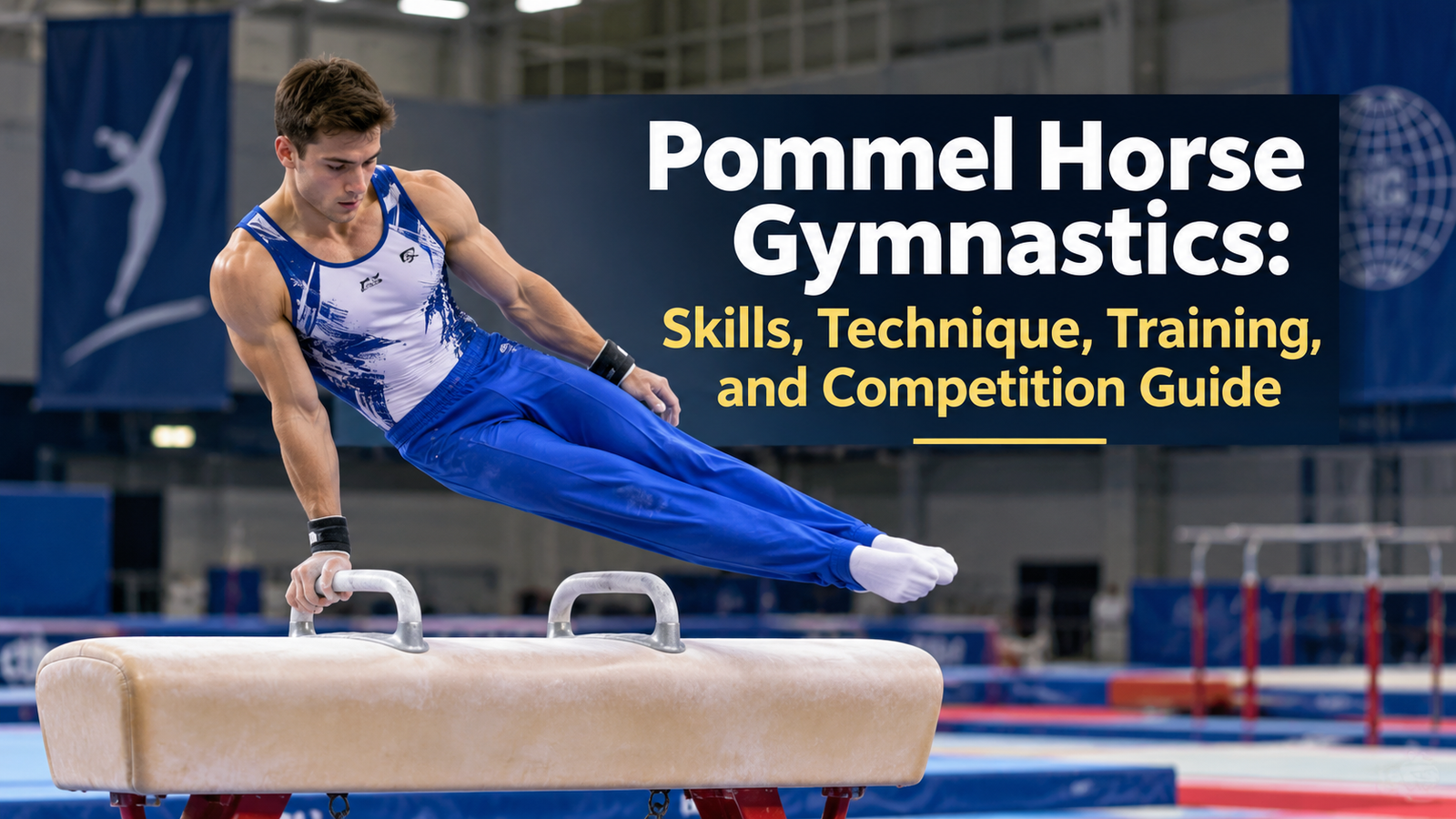
Pommel horse gymnastics is one of the most technical and demanding events in men’s artistic gymnastics. At first glance, the apparatus may appear simple. It consists of a padded body with two handles, known as pommels, placed on top. However, performing smoothly on the pommel horse requires excellent balance, shoulder strength, coordination, timing, flexibility, and body control.
Unlike many other gymnastics events, pommel horse routines are performed almost entirely with the hands supporting the gymnast’s body. The legs must continue moving around the apparatus while the athlete transfers weight from one arm to the other. Even a small mistake in rhythm or hand placement can interrupt the entire routine.
Because of this, the pommel horse is often considered one of the most challenging events to master. Gymnasts usually spend many years developing the basic circles and support positions before attempting advanced skills.
What Is the Pommel Horse?
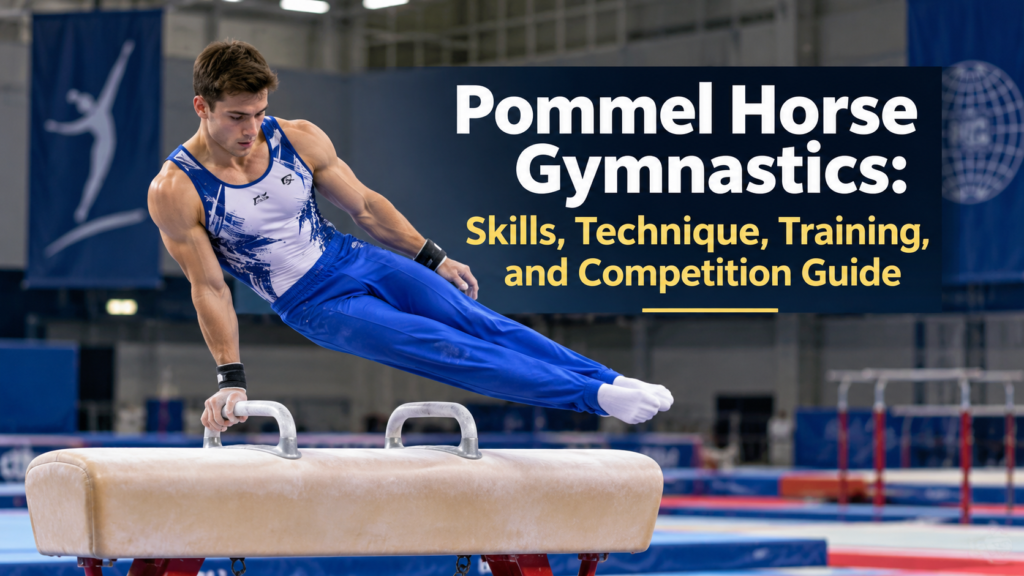
The pommel horse is an apparatus used in men’s artistic gymnastics competitions. It has a long padded body supported above the floor and includes two raised handles on the top surface.
The gymnast uses the handles and different areas of the horse to perform continuous swinging movements. Most skills involve circular leg movements, scissors, hand transfers, turns, travels, and transitions from one section of the apparatus to another.
A complete routine should look smooth and controlled. The gymnast tries to maintain a steady rhythm without stopping or losing balance.
Unlike the floor exercise, where gymnasts can perform jumps and tumbling skills, pommel horse routines focus heavily on continuous movement and upper body support.
History of the Pommel Horse
The pommel horse has a long history in gymnastics. Early versions of the apparatus were originally developed as training equipment for horseback riding.
Soldiers and riders used wooden structures to practice mounting and controlling their bodies while preparing for real horses. Over time, these training devices were adapted for physical education and gymnastics.
As organized gymnastics developed in Europe, the pommel horse gradually became a competitive apparatus. Gymnasts began creating more complex swinging movements instead of simply practicing mounting techniques.
Modern pommel horse routines are far more advanced than early exercises. Today, elite athletes perform highly technical combinations involving circles, turns, travels, and hand changes at impressive speed.
Structure of the Pommel Horse
A competition pommel horse includes several important parts.
The main body of the apparatus is long and slightly rounded. It is covered with padding to provide a secure surface for the gymnast’s hands.
Two pommels are attached to the top. These handles allow the athlete to support the body while performing circles and other skills.
The gymnast may place the hands on the pommels, the leather surface, or different areas of the apparatus depending on the skill being performed.
During a routine, athletes often travel from one end of the horse to the other. This ability to use multiple sections of the apparatus demonstrates control and technical variety.
The Basic Support Position
One of the first things beginners learn is the proper support position.
The gymnast supports the body with straight arms while keeping the shoulders strong and stable. The hips should remain controlled, and the body should stay lifted above the apparatus.
Good shoulder strength is essential because the gymnast constantly transfers body weight between the arms.
Beginners often struggle because they allow the shoulders to collapse or bend the elbows. This makes it much harder to maintain rhythm.
Developing a strong support position creates the foundation for almost every pommel horse skill.
Circles
Circles are among the most important movements in pommel horse gymnastics.
During a circle, the gymnast swings both legs together around the body while supporting the weight with the hands.
The legs should remain straight and together. The hips move around the apparatus while the hands alternate between support positions.
A high quality circle appears wide, smooth, and continuous.
Beginners usually learn circles on simpler training equipment before performing them on the full pommel horse.
Coaches may use mushroom trainers, floor circles, or low practice devices. These allow athletes to develop the correct body position without worrying about the full height of the competition apparatus.
Scissor Skills
Scissors are another traditional movement used on the pommel horse.
Instead of keeping both legs together, the gymnast separates the legs and swings them past each other in a scissor like motion.
Scissor skills require good flexibility and hip control. The athlete must create enough height so the legs can move freely without touching the apparatus.
Although circles are more common in modern routines, scissors remain an important part of pommel horse technique and competition requirements.
Travels Across the Horse
Advanced gymnasts perform skills that move from one section of the horse to another.
These movements are called travels.
During a travel, the gymnast continues circling while gradually changing hand positions and moving sideways along the apparatus.
The athlete may begin near one end of the horse, travel across the center, and finish near the opposite end.
Travels demonstrate strong control because the gymnast must maintain rhythm while constantly changing support positions.
They also make routines more visually interesting by allowing the athlete to use the entire apparatus.
Spindle Movements
A spindle is a movement where the gymnast rotates the body while continuing a circular motion.
The athlete may turn through part or all of a rotation while maintaining support on the horse.
Spindles require accurate hand placement and strong awareness of body position.
If the hands move too early or too late, the rhythm of the circle can be disrupted.
Advanced routines often combine spindles with travels and other circle variations.
Flop Sequences
Elite pommel horse routines may include complex sequences sometimes called flops.
These involve repeated circles or related movements performed while using specific hand positions around the pommels.
Flop combinations can increase the difficulty of a routine because several technical elements may be connected without interruption.
These combinations require excellent endurance because the gymnast must maintain shoulder support and rhythm for an extended period.
Russian Circles
Russian circles are another advanced type of pommel horse movement.
During these skills, the gymnast rotates around the hands while maintaining continuous movement above the apparatus.
The body travels through several positions as the hands shift around the horse.
Russian style movements demand accurate timing and strong shoulders.
They can also add significant difficulty to a routine when performed cleanly and connected with other skills.
The Importance of Rhythm
Rhythm is one of the most important qualities in pommel horse gymnastics.
A successful routine should look continuous from beginning to end.
Gymnasts try to avoid hesitation or sudden pauses between skills.
Maintaining rhythm requires careful coordination between the legs, hips, shoulders, and hands.
Even if the gymnast is physically strong, poor timing can cause the body to lose momentum.
For this reason, coaches often focus on consistent swinging patterns during basic training.
Once a gymnast develops reliable rhythm, more difficult skills can be added.
Strength Required for Pommel Horse
Pommel horse gymnastics requires strong shoulders, arms, wrists, and core muscles.
The shoulders support much of the gymnast’s body weight throughout the routine.
The arms must remain straight during most skills, which places additional demands on the shoulder joints and upper body.
Core strength helps the athlete control the legs and hips while circling around the apparatus.
Wrist strength is also important because the hands constantly change direction and support the body from different angles.
Gymnasts often perform conditioning exercises such as handstand holds, support holds, push ups, core exercises, and shoulder strengthening drills.
Flexibility and Mobility
Flexibility plays an important role in pommel horse performance.
Good hip flexibility allows the gymnast to create wider circles and higher scissor movements.
Shoulder mobility also helps athletes reach different hand positions comfortably.
Limited flexibility can make movements look tight or restricted.
Regular stretching and mobility training help gymnasts maintain the range of motion needed for efficient technique.
However, flexibility should always be combined with strength. Athletes need enough muscular control to stabilize their joints while moving through large ranges of motion.
Learning Pommel Horse Safely
Beginners should learn pommel horse skills gradually under qualified coaching.
Trying difficult movements too early can lead to poor technique or injury.
Most athletes begin with basic support exercises and simple leg swings.
They may then progress to circles on a mushroom trainer.
Once the gymnast can perform consistent circles, more advanced hand placements and travel movements can be introduced.
Soft mats are commonly placed around training equipment to reduce the impact of falls.
Coaches also monitor technique closely because incorrect hand or shoulder positions can place unnecessary stress on the wrists and joints.
Common Beginner Mistakes
Several mistakes are common when athletes first learn the pommel horse.
One problem is bending the arms. Straight arms provide better support and allow the body to swing more efficiently.
Another mistake is allowing the hips to drop too low. Strong circles usually require the hips to remain extended and lifted.
Separating or bending the legs can also reduce the quality of the movement.
Some beginners move their hands too slowly. Because the legs continue circling, the hands must change position at the correct moment.
Rhythm problems are also common. Beginners may pause between movements instead of maintaining a continuous swing.
Correcting these basic issues early can make advanced training much easier.
How Pommel Horse Routines Are Judged
In international gymnastics competition, pommel horse routines are evaluated using the scoring system established by the International Gymnastics Federation.
Judges consider both difficulty and execution.
The difficulty score is based on the value and combination of the skills performed.
The execution score evaluates how cleanly the gymnast performs the routine.
Judges may deduct points for mistakes such as bent legs, separated feet, poor body position, pauses, loss of rhythm, or contact with the apparatus.
A fall from the pommel horse results in a significant deduction.
Gymnasts therefore need to balance difficulty with consistency. Performing extremely difficult skills may increase the potential score, but mistakes can reduce the final result.
Competition Strategy
Gymnasts and coaches carefully design pommel horse routines.
The goal is to include enough difficult elements while maintaining a routine that the athlete can perform consistently.
A gymnast may choose specific circles, travels, spindles, and dismount combinations based on personal strengths.
Some athletes are particularly strong at traveling skills, while others perform complex work around the pommels.
Routine construction also considers endurance. Because the gymnast supports the body continuously, fatigue can affect technique near the end of the routine.
For this reason, athletes practice full routines repeatedly during training.
The Dismount
Every competitive pommel horse routine ends with a dismount.
The gymnast must leave the apparatus in a controlled way and land on the mat.
Advanced dismounts may involve turning movements while the gymnast pushes away from the horse.
The landing should be stable and controlled.
A large step or fall on landing can result in deductions.
Because the dismount occurs at the end of a demanding routine, gymnasts must maintain enough strength and concentration to finish successfully.
Training Equipment for Pommel Horse
Several types of training equipment help athletes develop pommel horse skills.
One of the most common is the mushroom trainer.
This rounded device does not have pommels and is often placed close to the floor.
Gymnasts use it to practice circles and basic body positions.
Some training gyms also use bucket systems where an athlete’s feet or legs are supported while learning the circular movement.
Low pommel horses are another useful progression before athletes move to the full competition apparatus.
These tools help gymnasts build confidence and technique gradually.
Mental Focus
Pommel horse gymnastics requires significant concentration.
Because the routine depends on continuous rhythm, a small moment of hesitation can cause a mistake.
Gymnasts must remember complex sequences while also reacting to their body position during each circle.
Confidence develops through repetition.
Athletes often practice individual skills many times before combining them into complete routines.
Mental preparation also helps gymnasts remain calm during competitions, where pressure can make technical skills more difficult.
Why Pommel Horse Is So Difficult
The pommel horse is difficult because several physical and technical demands must occur at the same time.
The gymnast must support the body with the arms, maintain straight legs, control the hips, shift the hands, travel across the apparatus, and preserve rhythm.
There are very few opportunities to pause or recover.
If the athlete loses momentum, continuing the routine can become extremely difficult.
This combination of strength, coordination, timing, and endurance makes the pommel horse one of the most respected events in artistic gymnastics.
Benefits of Pommel Horse Training
Training on the pommel horse develops many physical abilities.
It can improve shoulder strength, arm endurance, core stability, balance, coordination, flexibility, and body awareness.
Gymnasts also develop patience because progress often comes gradually.
Learning a clean circle may require hundreds or even thousands of repetitions.
This process teaches athletes to focus on small technical improvements.
Pommel horse training can also improve skills used on other gymnastics apparatus because strong shoulders and body control are valuable throughout artistic gymnastics.
Final Thoughts
Pommel horse gymnastics combines strength, balance, rhythm, flexibility, coordination, and precision. Although the apparatus looks relatively simple, performing a successful routine requires years of careful training.
Beginners normally start with support positions, swings, and circles before progressing to scissors, travels, spindles, Russian movements, and more complex combinations.
Elite gymnasts make these skills appear effortless, but each smooth routine is the result of extensive conditioning and technical practice.
The most successful pommel horse performances are not simply collections of difficult skills. They show continuous rhythm, clean body positions, confident hand placement, and control from the opening movement to the final dismount.
For anyone learning about artistic gymnastics, the pommel horse provides an excellent example of how strength and technique must work together. It remains one of the most distinctive and challenging events in the sport and continues to test the skill, patience, and precision of gymnasts around the world.