Gymnastics vault is one of the most exciting events in artistic gymnastics. It combines speed, strength, timing, body control, and confidence in a routine that lasts only a few seconds. A gymnast runs down a runway, jumps from a springboard, makes contact with the vaulting table, performs a skill in the air, and tries to land with complete control.
Although the vault happens very quickly, a successful performance requires years of training. Every part of the vault matters. The run must be powerful, the jump onto the springboard must be accurate, the contact with the table must be explosive, and the landing must be stable.
Vault is included in both men’s and women’s artistic gymnastics. The basic purpose is similar for all gymnasts, but the skills performed can vary greatly according to experience, competition level, and individual ability.
What Is Gymnastics Vault?
Gymnastics vault is an apparatus event in artistic gymnastics. Gymnasts use a runway, springboard, and specially designed vaulting table to generate enough power to perform aerial skills.
The event usually begins with a fast run. The gymnast approaches the springboard and uses it to convert forward speed into upward and forward movement. After reaching the vaulting table, the gymnast pushes strongly through the shoulders and hands before entering the flight phase.
During this flight, gymnasts may perform twists, flips, or other movements depending on the vault they choose.
The final goal is to land safely and under control.
Vault is different from events such as floor exercise or balance beam because there is very little time to make corrections once the gymnast begins the approach. Proper preparation is therefore extremely important.
The Main Equipment Used in Vault
Modern vaulting equipment is designed to support performance while improving safety.
The most important pieces of equipment are the runway, springboard, vaulting table, landing mats, and safety mats.
The runway provides enough distance for the gymnast to build speed before reaching the springboard. Gymnasts carefully measure their starting point so that every step matches their preferred approach.
The springboard contains springs that help the gymnast create upward power. Proper foot placement on the board is important because a poor position can reduce height and distance.
The vaulting table replaced the older vaulting horse used in previous generations of gymnastics. Its wider surface gives gymnasts more room for hand contact and generally provides a safer platform for advanced skills.
Landing mats are placed behind the table to absorb impact and provide a safer landing area.
Additional safety equipment may also be used during practice, especially when gymnasts are learning difficult skills.
The Four Main Phases of a Vault
A gymnastics vault can be divided into several important phases.
1. The Approach Run
The approach is the foundation of the entire vault.
Gymnasts accelerate down the runway and try to create controlled speed. Running too slowly may reduce power, while running without control can cause timing problems.
The gymnast must arrive at the springboard at exactly the correct distance.
Experienced gymnasts usually follow a carefully practiced number of steps. They repeat the same approach many times during training so that the movement becomes consistent.
The purpose of the run is not simply to reach maximum speed. The athlete must maintain proper posture and prepare for the transition onto the springboard.
2. The Springboard Phase
The gymnast reaches the springboard and performs a powerful jump.
The feet normally contact the board quickly before the gymnast moves toward the vaulting table.
This phase requires strong legs and accurate timing. Gymnasts try to spend very little time on the springboard because an effective vault depends on transferring energy quickly.
The movement into the springboard is often called the hurdle.
A well performed hurdle allows the gymnast to maintain momentum while preparing the body for contact with the vaulting table.
3. Contact With the Vaulting Table
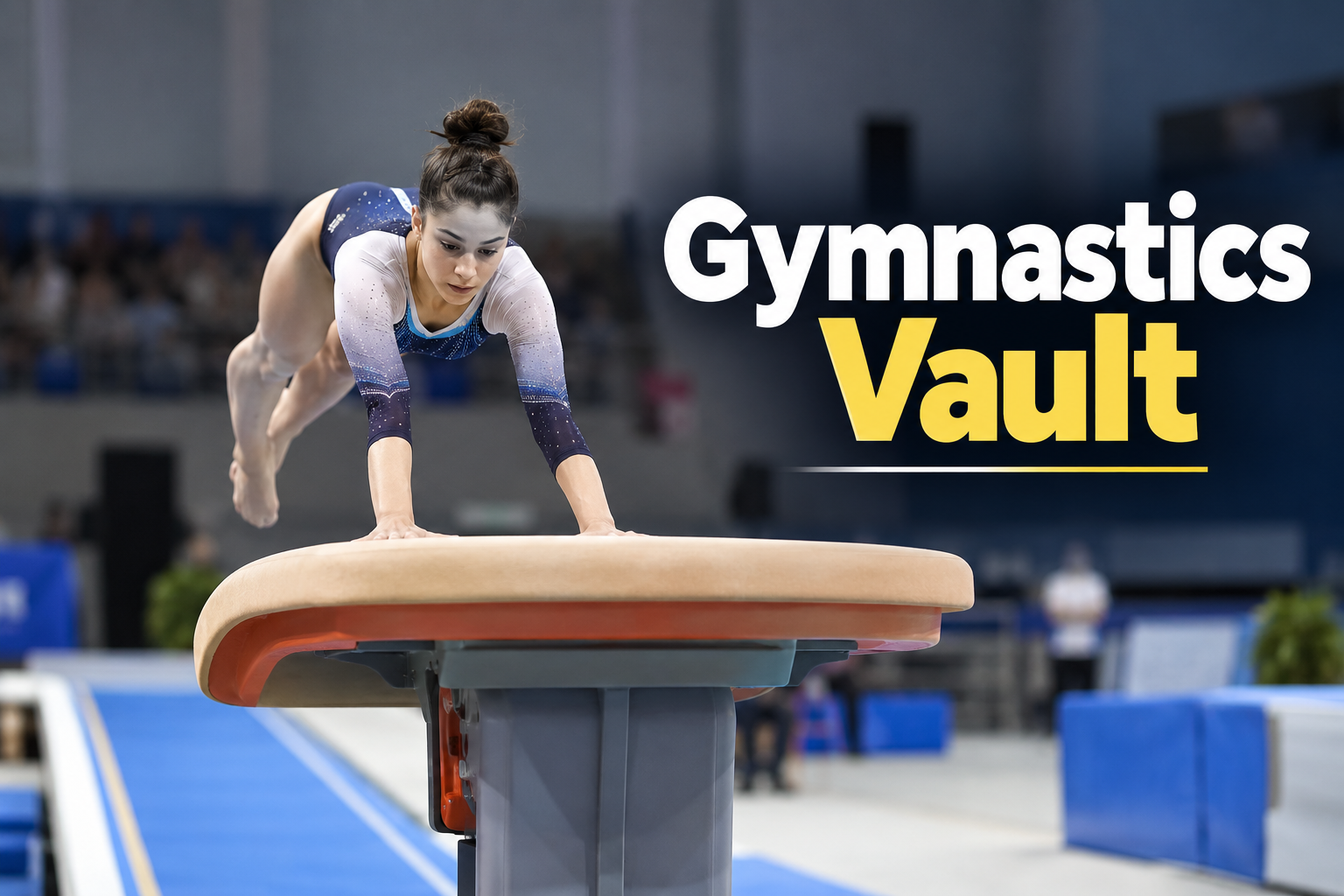
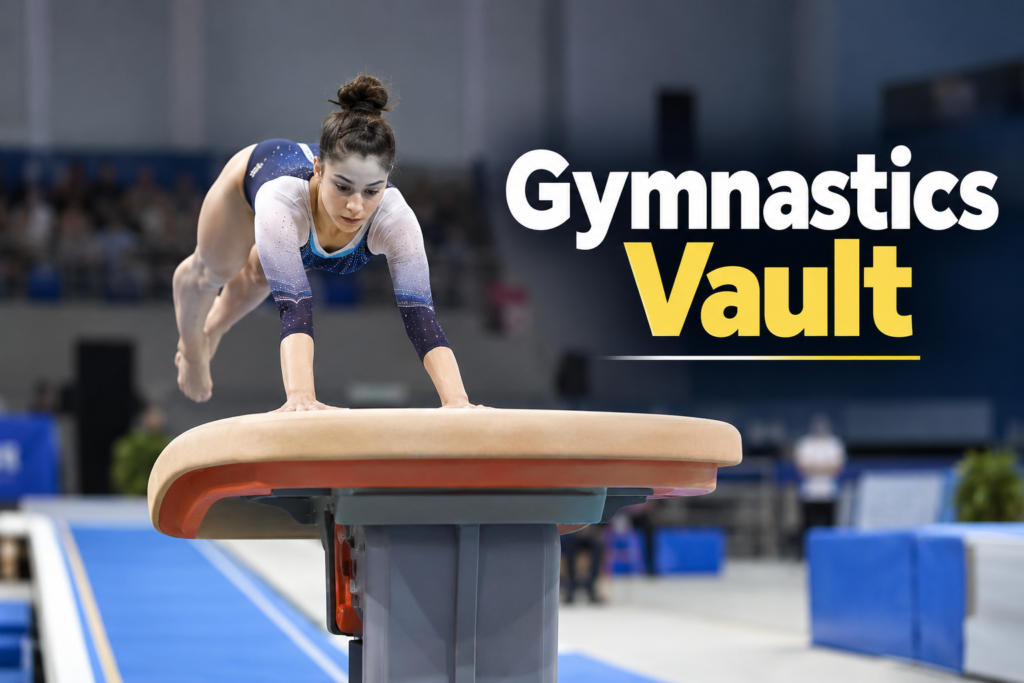
The next important phase is called the support or block phase.
The gymnast places the hands on the table and pushes strongly through the shoulders.
This action is often known as the block.
A powerful block helps create height and allows the gymnast enough time in the air to complete more difficult movements.
Strong shoulder action, correct body position, and precise hand placement are important during this phase.
Gymnasts do not simply push with their arms. The whole body contributes to the movement.
Poor technique during the block can reduce height and make the second flight more difficult.
4. Flight and Landing
After leaving the table, the gymnast enters the second flight phase.
This is where many advanced vaults become visually impressive.
The gymnast may perform flips, twists, or combinations of both.
Body position must remain controlled throughout the movement. The athlete also needs strong spatial awareness to understand where the body is in relation to the floor.
As the landing approaches, the gymnast prepares to absorb the impact.
A strong landing usually includes slightly bent knees, balanced posture, and minimal movement after the feet touch the mat.
A completely controlled landing without extra steps is often called a stuck landing.
Common Types of Gymnastics Vaults
Gymnastics vaults are commonly grouped according to how the gymnast approaches and contacts the table.
One of the most basic vaults learned by beginners is the handspring vault.
In this skill, the gymnast performs a forward movement onto the table and pushes away before landing.
More advanced gymnasts may add forward flips or twists after the handspring action.
Another major group includes Tsukahara style vaults.
These involve a turning movement onto the table followed by a backward flipping action during the flight phase.
Yurchenko style vaults are also extremely common in competitive gymnastics.
A Yurchenko vault usually begins with a roundoff onto the springboard. The gymnast then performs a backward entry onto the vaulting table before completing the chosen flight skill.
Advanced versions can include multiple twists or difficult saltos.
Different vault families require different combinations of speed, technique, coordination, and confidence.
Why Speed Is Important
Speed plays a major role in gymnastics vault.
The faster a gymnast runs while maintaining control, the more energy can potentially be transferred into the springboard and vaulting table.
However, successful vaulting is not simply about running as fast as possible.
The gymnast must use speed efficiently.
Poor timing can waste energy even if the athlete has a fast approach.
For this reason, vault training often includes sprinting exercises, approach drills, and repeated practice of the hurdle.
Coaches may also record gymnasts to study their steps and body position during the approach.
Strength Needed for Vault
Vault requires strength throughout the entire body.
Leg strength helps produce speed during the run and power during the springboard phase.
Shoulder and upper body strength are important during contact with the vaulting table.
Core strength helps maintain a tight body position while performing flips and twists.
Gymnasts often include exercises such as jumps, squats, core exercises, handstands, and conditioning drills in their training programs.
Explosive strength is especially valuable because vault movements happen very quickly.
The gymnast must produce significant force in a very short period.
Flexibility and Body Control
Flexibility also supports effective vaulting technique.
Good shoulder flexibility can help gymnasts reach strong positions during table contact.
Hip and leg flexibility may improve body alignment and help athletes perform certain flight positions more cleanly.
However, flexibility alone is not enough.
Gymnasts need excellent body awareness.
They must understand how to keep the body tight, when to open from a flip, and how to prepare for landing.
This awareness develops gradually through drills and repeated training.
How Gymnastics Vault Is Scored
Competitive vault scoring generally considers both difficulty and execution.
The difficulty value reflects the technical challenge of the selected vault.
More complicated twists, flips, and entry techniques usually have higher difficulty values.
The execution score evaluates how well the gymnast performs the skill.
Judges look at factors such as body position, technique, height, distance, form, and landing control.
Mistakes can result in deductions.
For example, gymnasts may lose points for bent legs, separated legs, poor body alignment, insufficient height, or unstable landings.
Large steps after landing can also affect the score.
Falling usually results in a significant deduction.
The exact scoring system may vary according to the governing organization, competition level, and current rules.
The Importance of Landing Technique
Landing is one of the most important parts of vault.
A gymnast can perform a difficult and powerful skill but lose valuable points if the landing is uncontrolled.
During landing, the athlete must absorb considerable force.
Proper technique helps distribute this force through the legs and body.
Gymnasts practice landing drills regularly.
These drills may include jumping from raised surfaces, landing from basic flips, and practicing balance after impact.
The goal is to develop a position that is both safe and visually controlled.
Coaches also teach gymnasts to recognize situations where protecting the body is more important than trying to force a perfect landing.
Safety in Gymnastics Vault
Safety should always be a priority when practicing vault.
Vault skills involve speed and height, so attempting advanced movements without preparation can be dangerous.
Gymnasts normally learn skills in stages.
Beginners may start with running drills, jumping exercises, handstand work, and basic vault movements.
As technique improves, coaches gradually introduce harder skills.
Spotting, foam pits, soft mats, training blocks, and other equipment can help athletes learn movements more safely.
Equipment should also be checked regularly.
The runway should be clear, the springboard should be positioned correctly, and mats should be secure.
Gymnasts should never attempt difficult vaults without appropriate coaching and preparation.
Vault Training for Beginners
Beginners usually focus on basic movement patterns before learning advanced vaults.
They may practice running with consistent steps and learning how to hurdle onto the springboard.
They also work on straight jumps, handstands, body tension, and safe landings.
Simple drills help gymnasts understand how to transfer energy from the run into the board and then into the vaulting surface.
Progress should be gradual.
Developing strong fundamentals can make advanced training safer and more effective later.
Rushing through basic skills often creates technical problems that become harder to correct.
Mental Confidence in Vault
Vault is not only a physical event.
Mental preparation is also important.
Because gymnasts approach the apparatus at high speed, hesitation can affect timing and technique.
Athletes develop confidence through repetition and gradual progression.
A gymnast who has successfully practiced each part of a vault many times is usually better prepared to perform the complete skill.
Coaches may also help athletes use visualization, breathing routines, and consistent preparation before each attempt.
Confidence does not mean ignoring risk.
Good gymnasts combine confidence with careful technical awareness.
Vault in Men’s and Women’s Gymnastics
Vault is included in both men’s artistic gymnastics and women’s artistic gymnastics.
The essential concept is the same in both competitions.
Athletes run, use the springboard, contact the table, perform an aerial skill, and land.
At elite levels, vaults can include highly advanced flipping and twisting combinations.
The event is popular with audiences because the action is fast and powerful.
A complete vault may last only a few seconds, yet it represents many hours of preparation.
Common Mistakes in Vault
Several technical mistakes can reduce the quality of a vault.
An inconsistent approach can cause the gymnast to reach the springboard at the wrong distance.
Poor board contact may reduce power.
Weak shoulder action on the table can limit flight height.
Loose body position may make twists and flips less controlled.
Landing too low or leaning heavily forward can also create problems.
Coaches normally correct these issues through specific drills rather than repeatedly asking the gymnast to perform the entire vault.
Breaking a skill into smaller sections can make improvement easier.
Why Vault Is Exciting to Watch
Vault is one of the most dynamic events in gymnastics.
There is a clear progression from the approach run to the explosive takeoff and aerial movement.
Spectators can easily appreciate the speed and height involved, even if they do not understand every technical detail.
The landing also creates a dramatic final moment.
When a gymnast completes a difficult vault and lands without taking a step, the performance can appear almost effortless.
Behind that moment, however, are strength training, flexibility work, technical drills, mental preparation, and thousands of repetitions.
Final Thoughts
Gymnastics vault is a powerful combination of athletic ability and precise technique. The event requires gymnasts to convert running speed into explosive movement while maintaining complete control of their bodies.
Successful vaulting depends on every stage working together. The approach creates momentum, the springboard helps generate power, the vaulting table provides the opportunity for an explosive block, and the flight phase allows the gymnast to demonstrate technical difficulty.
A controlled landing completes the performance.
For beginners, learning strong fundamentals is more important than attempting advanced skills too early. Consistent running, correct springboard technique, body tension, handstand strength, and safe landing habits create the foundation for future development.
At higher levels, gymnasts combine these basics with complex flips and twists that make vault one of the most impressive events in artistic gymnastics.
Whether someone is learning gymnastics, coaching athletes, or simply watching a competition, understanding the different parts of the vault makes the event easier to appreciate. What appears to be only a few seconds of action is actually the result of careful technique, physical preparation, and long term training.