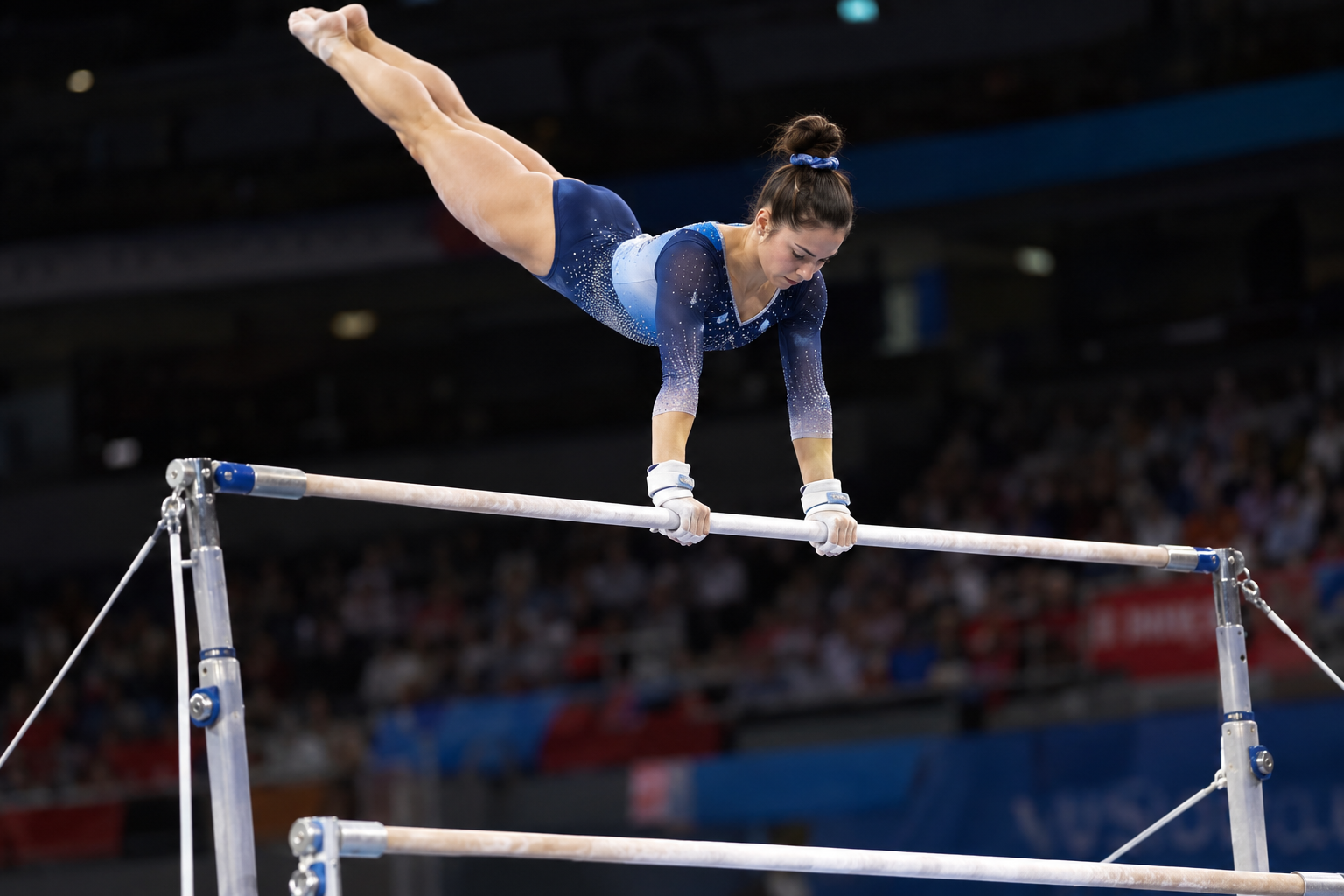
Uneven bars gymnastics is one of the most exciting events in women’s artistic gymnastics. It combines strength, flexibility, speed, timing, coordination, and courage. During an uneven bars routine, a gymnast swings between two horizontal bars that are positioned at different heights. The gymnast performs turns, releases, catches, transitions, handstands, and a final dismount, all while trying to keep the routine smooth and controlled.
To someone watching gymnastics for the first time, an uneven bars routine may look like a continuous series of swings. In reality, every movement requires careful technique. The gymnast must know exactly when to release the bar, how to position the body in the air, where to look while catching, and how to maintain enough momentum for the next skill.
Uneven bars gymnastics has developed greatly over the years. Modern routines are faster, more difficult, and more creative than many routines performed in earlier generations. Gymnasts now use complex combinations and impressive release skills that require years of training.
What Are the Uneven Bars?
The uneven bars are two horizontal bars placed parallel to each other at different heights. One bar is called the low bar, while the other is known as the high bar.
The gymnast uses both bars during a routine. She may begin on the low bar, high bar, or by performing an entry skill. During the routine, she moves between the two bars while performing different elements.
Unlike traditional metal bars, modern uneven bars are designed to provide some flexibility. This helps the bars respond to the gymnast’s movements during large swings and release skills.
The distance between the bars can usually be adjusted within the rules of competition so that gymnasts can perform safely and comfortably.
The Purpose of an Uneven Bars Routine
The goal of an uneven bars routine is not simply to complete difficult tricks. A successful performance should combine difficulty with clean technique and smooth movement.
Judges look for several qualities during a routine, including body position, control, height, rhythm, handstands, transitions, and the landing of the dismount.
A gymnast must also connect different skills together effectively. Long pauses or unnecessary adjustments can reduce the quality of the routine.
The best uneven bars routines often appear effortless. The gymnast continues moving naturally from one skill into another without breaking the flow of the performance.
Basic Uneven Bars Skills
Before learning advanced skills, gymnasts usually spend a significant amount of time practicing basic movements.
One of the most important basic skills is the swing. Gymnasts learn how to swing forward and backward while maintaining a controlled body shape. Proper swinging technique is essential because many advanced skills begin from a powerful swing.
Another important skill is the cast. During a cast, the gymnast pushes away from the bar and raises the body. Beginners may perform small casts, while advanced gymnasts often cast directly into a handstand.
Support positions are also important. Gymnasts must learn how to hold their body above the bar while keeping the arms straight and maintaining control.
Kips are another fundamental part of uneven bars gymnastics. A kip allows the gymnast to move from a hanging position into a support position on the bar. Although the movement may appear simple, learning a technically correct kip can take considerable practice.
These basic skills create the foundation for more difficult gymnastics.
Handstands on Uneven Bars
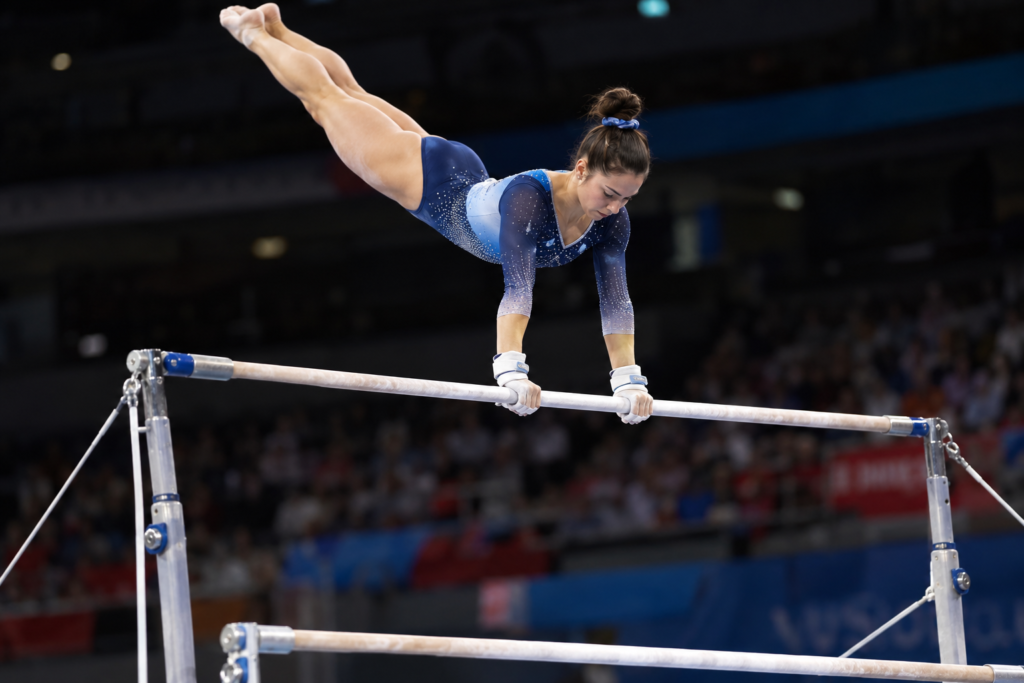
Handstands are extremely important in modern uneven bars routines.
During many skills, gymnasts are expected to reach a vertical handstand position. A good handstand requires the shoulders, hips, legs, and feet to remain aligned.
Judges may make deductions when a gymnast fails to reach the correct angle during certain elements.
Because of this, gymnasts spend a great deal of training time practicing handstand positions.
Strong shoulders and core muscles are essential for controlling a handstand on the bars. Gymnasts must also develop strong body awareness because they often reach the handstand while moving at high speed.
Giants
One of the most recognizable uneven bars skills is the giant swing.
During a giant, the gymnast rotates completely around the bar while keeping the arms straight. The body passes through a handstand position at the top of the movement.
Giants help generate momentum for difficult release moves and dismounts.
Gymnasts can perform giants in different ways. Some may use a straight body position, while other techniques and variations can be used depending on the skill that follows.
A technically strong giant allows the gymnast to maintain speed and prepare for the next element without interruption.
Release Moves
Release moves are among the most dramatic skills in uneven bars gymnastics.
During a release move, the gymnast lets go of the bar, performs a movement in the air, and catches the same bar again.
These skills require excellent timing. Releasing too early or too late can make the catch extremely difficult.
Gymnasts must also generate enough height so that they have time to complete the movement safely.
Release moves can include flips, twists, straddle movements, and other aerial actions.
These skills often become highlights of competitive routines because they demonstrate both difficulty and confidence.
Transitions Between the Bars
Another important part of uneven bars gymnastics involves moving from one bar to the other.
These movements are known as transitions.
A gymnast may perform a transition from the low bar to the high bar or from the high bar to the low bar.
Transitions can involve releases, flight elements, turns, or other movements.
Good transitions should appear natural within the routine. The gymnast should maintain speed and rhythm while moving between the bars.
Because the bars are positioned at different heights, transitions require accurate body positioning and careful control.
Pirouettes and Turns
Pirouettes are turning movements usually performed while the gymnast is supported by the bar.
During some pirouettes, the gymnast passes through or near a handstand position while changing the position of the hands.
Turns can add difficulty and variety to the routine.
They also require strong shoulder flexibility and precise hand placement.
If the gymnast turns too early or too late, the movement may affect the rhythm of the routine or make the next skill more difficult.
Connecting Skills
Skill connections are an important part of high level uneven bars gymnastics.
Instead of performing each skill separately, gymnasts often connect multiple elements together.
For example, a gymnast may perform a transition immediately followed by a release skill and then continue directly into another movement.
Connections can increase the overall difficulty of a routine when they meet the required standards.
However, combining skills also increases the challenge. The gymnast has less time to correct body position or prepare for the next movement.
Strong conditioning and excellent technique are therefore essential.
The Uneven Bars Dismount
Every uneven bars routine ends with a dismount.
During the dismount, the gymnast releases the bar and performs a flipping or twisting movement before landing on the mat.
Dismounts can range from relatively simple movements to extremely difficult combinations involving multiple flips or twists.
The landing is an important part of the routine.
A gymnast tries to land with control while minimizing steps or movements after the feet touch the mat.
A perfectly controlled landing with no visible movement is often called a stuck landing.
A strong dismount can create an impressive finish to the entire performance.
How Uneven Bars Routines Are Scored
Modern gymnastics scoring usually separates the evaluation into difficulty and execution.
The difficulty portion considers the value of the skills performed and certain connections between elements.
More difficult skills generally receive higher values.
The execution portion evaluates how well the routine is performed.
Judges may make deductions for several mistakes, including bent arms, separated legs, flexed feet, incomplete handstands, poor body alignment, steps on landing, or falls.
Small technical errors can reduce the score even when the gymnast successfully completes all the major skills.
For this reason, gymnasts must balance difficulty with consistency.
Performing extremely difficult skills is valuable only when the gymnast can complete them with reasonable control.
Strength Needed for Uneven Bars
Uneven bars gymnastics requires exceptional upper body strength.
Gymnasts need strong shoulders, arms, back muscles, abdominal muscles, and grip strength.
However, strength alone is not enough.
Gymnasts must also learn how to use momentum efficiently.
A gymnast who understands body positioning can generate large amounts of swing without relying completely on muscular strength.
Core strength is especially important because gymnasts must constantly control the shape of the body while swinging, turning, and releasing from the bar.
Flexibility and Mobility
Flexibility is another important part of uneven bars training.
Shoulder flexibility allows gymnasts to move comfortably through large swinging movements.
Hip and hamstring flexibility can also help with certain skills and body positions.
Mobility training is often included in gymnastics practice to help athletes maintain safe movement patterns.
However, flexibility should usually be developed gradually. Forcing joints beyond a comfortable range can increase the risk of injury.
Grip and Hand Protection
Gymnasts place significant pressure on their hands while training on uneven bars.
Repeated swinging can cause friction between the hands and the bar.
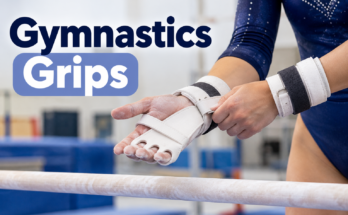
Advanced gymnasts often use gymnastics grips. These pieces of equipment are worn on the hands and help improve grip while providing some protection.
Gymnasts may also use chalk to reduce moisture and improve friction.
Even with grips, hand care remains important.
Gymnasts may develop calluses or small skin tears during intensive training. Proper care and recovery can help prevent minor hand problems from becoming more serious.
Safety in Uneven Bars Training
Safety is essential when learning uneven bars gymnastics.
New skills should normally be practiced under the supervision of qualified gymnastics coaches.
Coaches may use spotting techniques, training mats, foam pits, straps, or other equipment when gymnasts are learning difficult movements.
Progression is also important.
A gymnast should usually develop the necessary strength and basic technique before attempting advanced skills.
Learning skills too quickly can increase the risk of falls or injuries.
Regular conditioning, flexibility work, proper warm ups, and adequate recovery all contribute to safer training.
Common Mistakes on Uneven Bars
Several common mistakes can affect an uneven bars routine.
Bent arms are one frequent problem. Gymnasts generally try to keep their arms straight during many swinging and support elements.
Leg separation is another common deduction. Unless a skill requires a straddle position, gymnasts usually try to keep their legs together.
Flexed feet can also affect the appearance of a routine. Pointed toes create cleaner body lines.
Handstand angles are especially important. Stopping short of vertical can reduce the quality of the skill.
Gymnasts may also lose rhythm when they hesitate before a difficult movement.
Improving these details often separates a good routine from an excellent one.
Mental Preparation
Uneven bars gymnastics requires confidence as well as physical ability.
Release skills can feel intimidating because the gymnast temporarily loses contact with the equipment.
Athletes often practice difficult skills many times using safer training setups before attempting them in a full routine.
Mental preparation can include visualization, breathing techniques, repetition, and consistent practice.
Confidence usually develops gradually as the gymnast becomes more familiar with the movement.
Why Uneven Bars Gymnastics Is So Impressive
Uneven bars gymnastics demonstrates a remarkable combination of athletic abilities.
Gymnasts must generate powerful swings while maintaining elegant body positions. They must know exactly when to release the bar and trust their ability to catch it again.
At the same time, they must perform under competitive pressure while judges evaluate even small technical details.
What makes the event particularly interesting is the continuous movement.
Unlike some gymnastics events where athletes can briefly pause between skills, uneven bars routines often require constant momentum.
One movement leads directly into another.
This combination of power, precision, timing, and creativity makes uneven bars one of the most fascinating events in artistic gymnastics.
Conclusion
Uneven bars gymnastics is a highly technical event that requires years of training and dedication. Gymnasts must develop strength, flexibility, timing, body awareness, confidence, and precise technique.
A successful routine combines basic skills, handstands, giant swings, transitions, release moves, turns, connections, and a controlled dismount.
Although spectators may only see a routine that lasts a short time, each performance represents countless hours of practice.
From the first basic swing to advanced aerial releases, every stage of uneven bars training builds toward greater control and difficulty.
For gymnasts, coaches, and fans, the uneven bars remain one of the most exciting examples of what can be achieved through disciplined training, technical knowledge, and athletic skill.