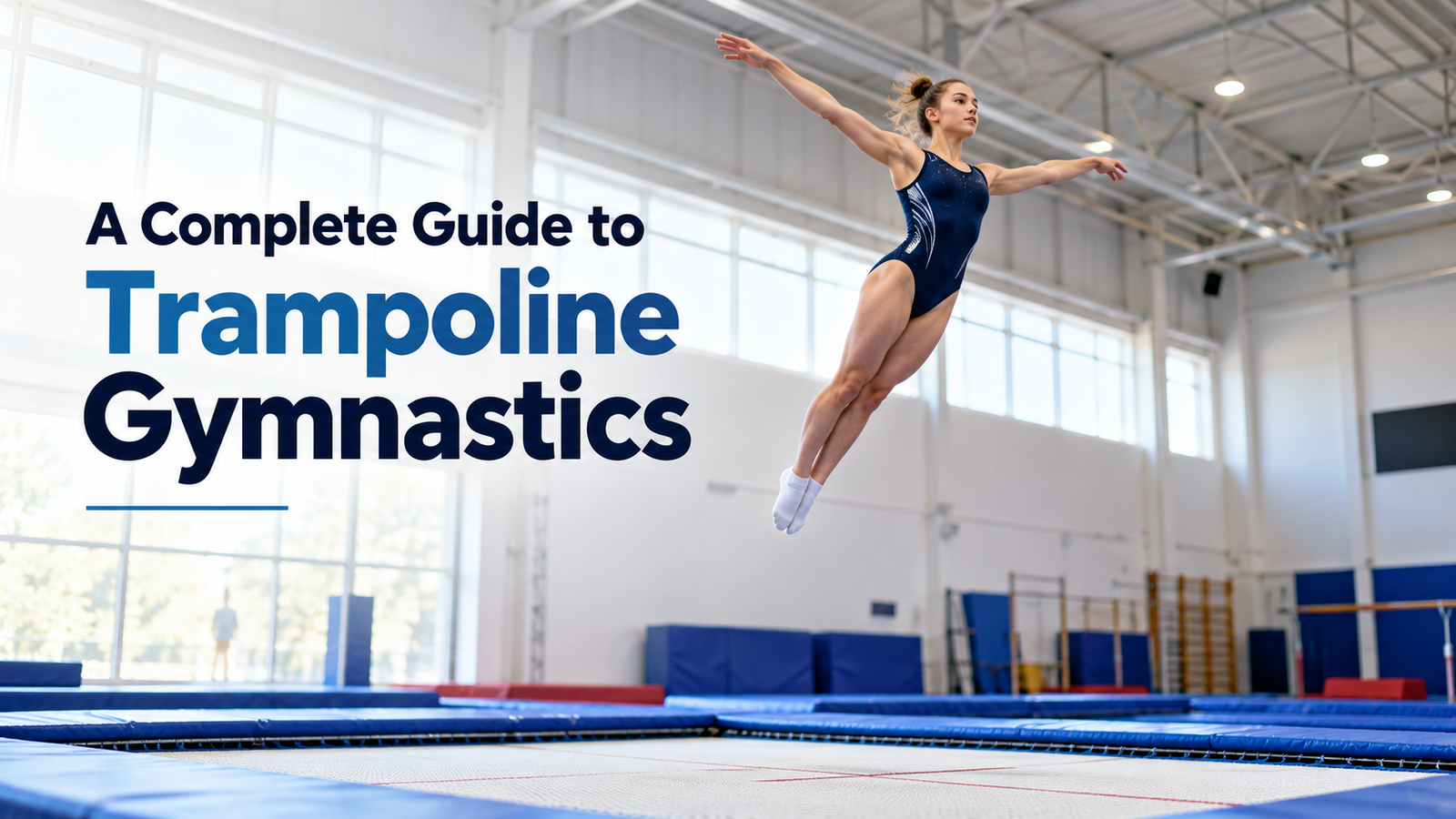
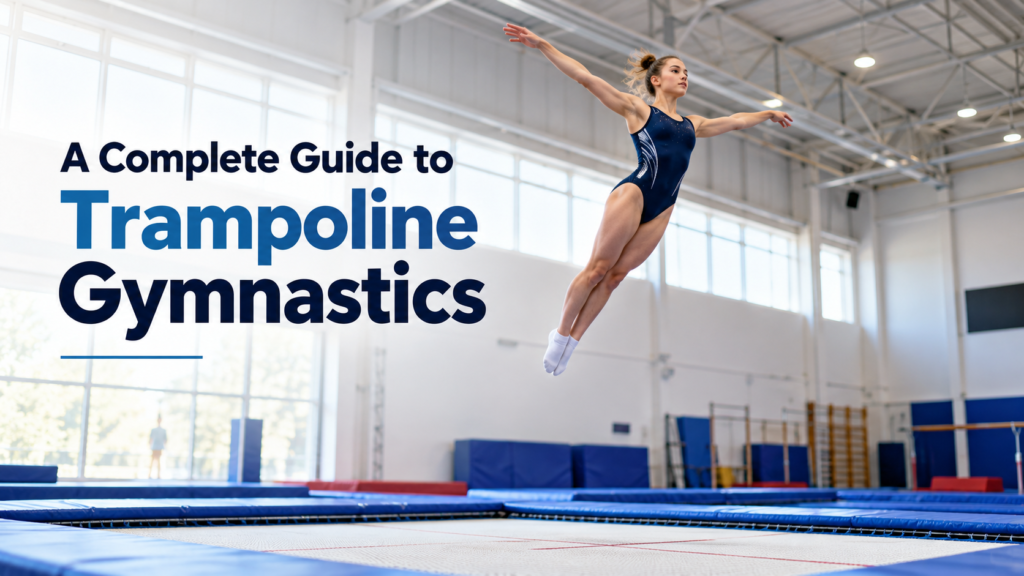
Trampoline gymnastics is one of the most exciting disciplines in the world of gymnastics. It combines athletic strength, body control, balance, flexibility, timing, and courage. Athletes perform a series of jumps, twists, somersaults, and other aerial movements while using a trampoline to gain height.
To someone watching for the first time, trampoline gymnastics may look like a simple activity based on jumping. In reality, competitive trampoline requires years of practice, careful technique, physical conditioning, and precise control of the body in the air. Gymnasts must know exactly where they are during every rotation and must prepare for a safe landing within a very small area.
Today, trampoline gymnastics is practiced recreationally and competitively around the world. It is also an Olympic sport, which has helped increase its popularity among young athletes and gymnastics fans.
What Is Trampoline Gymnastics?
Trampoline gymnastics is a gymnastics discipline in which athletes perform acrobatic skills while bouncing on a specially designed trampoline.
The trampoline used in competition is very different from the small recreational trampolines commonly found in gardens or play areas. Competitive trampolines are large, powerful pieces of equipment designed to help skilled athletes reach significant heights.
During a routine, the gymnast performs a sequence of skills without stopping. These movements can include straight jumps, tuck jumps, pike positions, twists, front somersaults, back somersaults, and combinations involving several rotations.
The goal is not simply to jump as high as possible. A successful trampoline gymnast must maintain control, stay near the center of the trampoline, perform each movement correctly, and complete the routine with a controlled landing.
The History of Trampoline Gymnastics
Modern trampoline development began during the twentieth century.
Early forms of bouncing equipment had existed for many years, but the modern trampoline became more organized when gymnasts and acrobatic performers began using flexible beds to practice aerial movements.
The modern competitive trampoline is often associated with George Nissen, an American gymnast who helped develop and promote trampoline equipment during the 1930s. He reportedly became interested in bouncing techniques after observing circus performers.
As trampoline equipment improved, the activity became increasingly popular for recreation, physical training, and competitive sport.
International competitions eventually developed, and trampoline gymnastics gained recognition as a serious gymnastics discipline.
One of the biggest moments in the history of the sport came when individual trampoline became part of the Olympic program at the Sydney Olympic Games in 2000.
Since then, Olympic competition has helped introduce trampoline gymnastics to millions of viewers around the world.
How a Trampoline Routine Works
In competitive trampoline gymnastics, athletes perform a sequence of connected skills.
A routine is usually designed to demonstrate technical ability, height, control, and difficulty. Gymnasts must continue bouncing while moving smoothly from one skill to another.
Even small mistakes can affect the performance. For example, traveling too far toward one side of the trampoline can reduce the quality of the routine and may make the next skill more difficult.
Athletes must therefore develop excellent spatial awareness.
They need to know the position of their arms, legs, head, and body while rotating in the air. They must also identify the trampoline quickly as they prepare to land.
High level routines can include several complicated somersaults and twists. These movements may happen very quickly, but the gymnast must remain relaxed enough to maintain control.
Basic Trampoline Gymnastics Skills
Beginners normally start with basic jumping techniques before attempting acrobatic movements.
The straight jump is one of the first skills a gymnast learns. The body remains upright and extended while the athlete jumps vertically and lands on the feet.
Another common beginner movement is the tuck jump. During this skill, the gymnast brings the knees toward the chest while airborne before extending the legs for landing.
The pike jump requires the legs to remain straight while the upper body folds forward toward them.
A straddle jump involves separating the legs to the sides while reaching toward the feet.
Gymnasts may also learn seat landings, where they land briefly in a seated position before returning to their feet.
These movements may appear simple, but learning them correctly creates the foundation needed for more advanced trampoline skills.
Advanced Trampoline Skills
As gymnasts develop greater confidence and control, they begin learning somersaults and twisting movements.
A front somersault involves rotating forward in the air before returning to the trampoline.
A back somersault requires backward rotation and usually demands greater awareness because the gymnast cannot always see the trampoline during the early part of the movement.
Twists involve rotating around the vertical axis of the body.
Advanced gymnasts combine somersaults and twists into complex skills. Some competitive routines include multiple rotations within a single jump.
Performing these skills requires excellent timing. Beginning a rotation too early or too late can affect the gymnast’s landing position.
For this reason, advanced trampoline skills are normally learned gradually under the supervision of qualified coaches.
The Importance of Body Control
Body control is one of the most important abilities in trampoline gymnastics.
A gymnast must control the body’s shape while moving through the air. Changes in body position affect rotation speed.
For example, bringing the body into a tight tuck can make a somersault rotate faster. Opening the body at the correct moment helps slow the rotation and prepare for landing.
Gymnasts therefore spend considerable time practicing body positions away from the trampoline.
Strength exercises, flexibility training, balance work, and basic gymnastics conditioning can all contribute to improved control.
Core strength is especially important because the abdominal and back muscles help stabilize the body during jumps and rotations.
Height and Timing
Competitive trampoline gymnasts can reach impressive heights during routines.
Greater height gives an athlete more time to complete difficult movements. However, jumping higher also requires stronger control.
The gymnast must contact the trampoline correctly so that the next bounce travels vertically rather than sideways.
Timing is equally important.
When an athlete lands on the trampoline, the bed stretches downward before pushing the gymnast upward again. The athlete must coordinate body movement with this rebound.
Learning to use the trampoline’s energy efficiently allows gymnasts to maintain consistent height without unnecessary movement.
Different Events in Trampoline Gymnastics
Trampoline gymnastics includes several different events.
Individual trampoline is probably the most recognized form. One gymnast performs alone on a trampoline and completes a sequence of skills.
Synchronized trampoline involves two athletes performing similar routines simultaneously on separate trampolines placed next to each other. Their movements should match closely in timing and technique.
Double mini trampoline is another discipline. Athletes run toward a smaller angled trampoline, perform acrobatic movements, and then land on a mat.
Tumbling is also commonly included within the broader trampoline gymnastics category. Tumblers perform fast combinations of somersaults and twists along a long spring track.
Each discipline requires slightly different skills, although they all depend heavily on coordination, power, and aerial awareness.
How Trampoline Gymnastics Is Judged
Competitive trampoline routines are evaluated according to several factors.
Execution is extremely important. Judges look at the athlete’s body position, control, form, and landings.
Difficulty also affects the final result. More complicated movements generally receive higher difficulty values.
Another important factor is horizontal displacement. Gymnasts are expected to remain close to the center of the trampoline throughout the routine.
Time of flight may also contribute to scoring in certain competitions. This measures how much time the gymnast spends in the air.
Because several scoring elements are involved, athletes must balance difficulty with consistency. Attempting extremely difficult skills may not be useful if they cannot be performed cleanly.
Physical Benefits of Trampoline Gymnastics
Regular trampoline training can develop several physical abilities.
Jumping repeatedly can improve leg strength and muscular endurance. Core muscles also work continuously to stabilize the body during flight and landing.
Trampoline gymnastics can improve coordination because athletes must control several parts of their body simultaneously.
Balance and spatial awareness also develop through regular practice.
Flexibility is useful for performing correct body positions, while cardiovascular fitness can help athletes maintain energy during training sessions.
Perhaps most importantly, structured gymnastics training teaches athletes how to control movement carefully rather than simply relying on power.
Mental Skills Required
Trampoline gymnastics is not only physically demanding. It requires strong mental concentration.
Athletes must remember complete routines while performing movements that happen within seconds.
Confidence is also important because advanced skills involve rotating high above the trampoline.
However, good training is not about removing fear completely. Athletes learn to understand risk, follow progressions, and perform skills only when they have developed the necessary preparation.
Patience is another valuable quality.
Complex trampoline skills may require hundreds or even thousands of repetitions before they become consistent.
Successful gymnasts learn from small mistakes and gradually improve their technique.
Safety in Trampoline Gymnastics
Safety should always be a major priority in trampoline training.
Beginners should learn from experienced coaches in suitable gymnastics facilities.
Protective mats are normally placed around competitive trampolines to reduce the risk of injury if an athlete leaves the trampoline area.
Coaches may also use spotting techniques and training equipment when teaching difficult movements.
Athletes should never attempt advanced somersaults simply because they have seen someone else perform them.
Gymnastics skills are usually taught through progressions. A gymnast first learns basic body positions and simpler rotations before moving toward advanced combinations.
Proper warm ups are also important because they prepare muscles and joints for training.
Equipment should be regularly inspected, and athletes should follow the safety rules of the training facility.
Training for Trampoline Gymnastics
A typical training program may include much more than jumping.
Gymnasts often begin with a warm up that includes light movement, stretching, and mobility exercises.
Strength training may include exercises for the legs, shoulders, back, and abdominal muscles.
Athletes also practice body shapes such as tuck, pike, and straight positions.
Basic bouncing exercises help improve control and consistency.
More advanced skills are then practiced according to the gymnast’s experience level.
Coaches may sometimes use video analysis to help athletes understand technical mistakes that are difficult to notice while performing.
Regular repetition helps the gymnast develop automatic movement patterns that can improve confidence and consistency.
Trampoline Gymnastics for Beginners
Someone interested in trampoline gymnastics does not need to begin with difficult tricks.
The best starting point is usually learning how to jump vertically and land in the center of the trampoline.
Beginners should focus on posture, balance, controlled bouncing, and simple body positions.
Progress may feel slow at first, but strong fundamentals make advanced skills much easier to learn later.
Joining a gymnastics club with trained coaches can provide a structured learning environment.
Beginners should also understand that every athlete develops at a different speed. Some people learn certain movements quickly while others require more practice.
Consistency is usually more valuable than rushing.
Competitive Trampoline Gymnastics
Competitive trampoline requires significant commitment.
Athletes may train several times each week, depending on their age and competitive level.
At higher levels, routines are carefully planned to maximize difficulty while maintaining strong execution.
Gymnasts and coaches study each skill combination and determine which sequences provide the best balance between technical challenge and reliability.
Competitions can range from local club events to national championships and major international competitions.
For elite athletes, reaching the Olympic Games represents one of the highest achievements in individual trampoline gymnastics.
Why Trampoline Gymnastics Is So Popular
One reason trampoline gymnastics attracts attention is its visual excitement.
Athletes appear to float above the trampoline while performing rapid rotations that would seem impossible to an untrained observer.
The sport also offers clear progression.
A beginner may start by learning basic jumps and gradually develop toward more complicated movements.
This progression can provide a strong sense of achievement.
Trampoline gymnastics can also appeal to people who enjoy both individual challenge and structured coaching.
Although competitors perform individually in many events, training often takes place in a supportive team environment.
Final Thoughts
Trampoline gymnastics is much more than jumping on a trampoline. It is a highly technical sport that combines strength, flexibility, coordination, timing, balance, concentration, and aerial awareness.
From basic straight jumps to advanced twisting somersaults, every skill depends on careful preparation and control.
The sport has grown from a specialized training activity into an internationally recognized gymnastics discipline and an Olympic event.
For beginners, the most important step is building strong fundamentals under proper supervision. For competitive athletes, continued training can lead to increasingly advanced routines and higher levels of competition.
Whether someone participates recreationally or dreams of becoming an elite athlete, trampoline gymnastics offers an exciting way to develop physical ability, confidence, discipline, and control.