Rhythmic gymnastics is one of the most graceful and visually impressive forms of gymnastics. It combines athletic skill, dance, flexibility, balance, coordination, and musical expression into a single performance. Unlike artistic gymnastics, which uses apparatus such as the vault, uneven bars, balance beam, and floor exercise, rhythmic gymnastics focuses mainly on floor routines performed with handheld apparatus.
The sport is known for flowing movements, elegant choreography, high flexibility, precise timing, and creative use of equipment. Gymnasts perform routines with a rope, hoop, ball, clubs, or ribbon while moving in harmony with music. Every movement must look controlled, expressive, and connected.
Rhythmic gymnastics requires much more than flexibility. Athletes must develop strength, endurance, body awareness, coordination, concentration, and confidence. Behind every smooth routine are many hours of training and repetition.
What Is Rhythmic Gymnastics?
Rhythmic gymnastics is a competitive sport in which athletes perform choreographed routines that combine gymnastics, dance, and apparatus handling. Most routines are performed on a large floor area with music playing in the background.
The gymnast moves continuously throughout the routine. She may leap, turn, balance, roll, bend, throw an apparatus into the air, catch it, and transition into another movement without stopping.
The aim is to create a performance that looks natural and artistic while also demonstrating technical difficulty.
Rhythmic gymnastics is especially popular because it combines sport and performance. The gymnast is not only demonstrating physical ability but also communicating emotion, rhythm, and style through movement.
History of Rhythmic Gymnastics
The development of rhythmic gymnastics was influenced by several European movement and dance systems during the nineteenth and early twentieth centuries.
Teachers and movement specialists began experimenting with exercises that combined physical movement, music, rhythm, and expression. Over time, these ideas developed into organized forms of rhythmic movement and eventually into a competitive sport.
International competitions helped standardize the sport and establish common rules.
Rhythmic gymnastics became an Olympic sport for individual athletes in 1984. Group competition was later added to the Olympic program in 1996.
Today, the sport is practiced in many countries and is governed internationally by the Fédération Internationale de Gymnastique, commonly known as FIG.
Main Apparatus Used in Rhythmic Gymnastics
One of the most interesting features of rhythmic gymnastics is the use of handheld apparatus. Each apparatus requires different handling skills and creates a different visual effect.
Rope
The rope requires speed, coordination, and accurate timing.
Gymnasts may swing, circle, throw, catch, or skip through the rope. They may also perform jumps and leaps while controlling it.
Because rope movements often happen quickly, the gymnast must maintain good hand and eye coordination.
Hoop
The hoop is one of the most recognizable pieces of rhythmic gymnastics equipment.
Gymnasts roll it along the floor, rotate it around different parts of the body, throw it into the air, pass through it, and catch it in different positions.
A successful hoop routine requires accurate control because even a small mistake can cause the hoop to roll away.
Ball
The rhythmic gymnastics ball is designed for smooth and flowing movements.
Gymnasts roll the ball over their arms, shoulders, back, or legs. They may also bounce, throw, catch, or balance it.
A major challenge is making the ball appear connected to the body rather than simply being held.
Ball routines often emphasize elegance, control, and fluid motion.
Clubs
Clubs are used in pairs, which makes them particularly demanding.
The gymnast may swing, rotate, throw, catch, tap, or circle the clubs. Since both hands are often working independently, strong coordination is necessary.
Club routines can include fast movements and complex patterns that require excellent concentration.
Ribbon
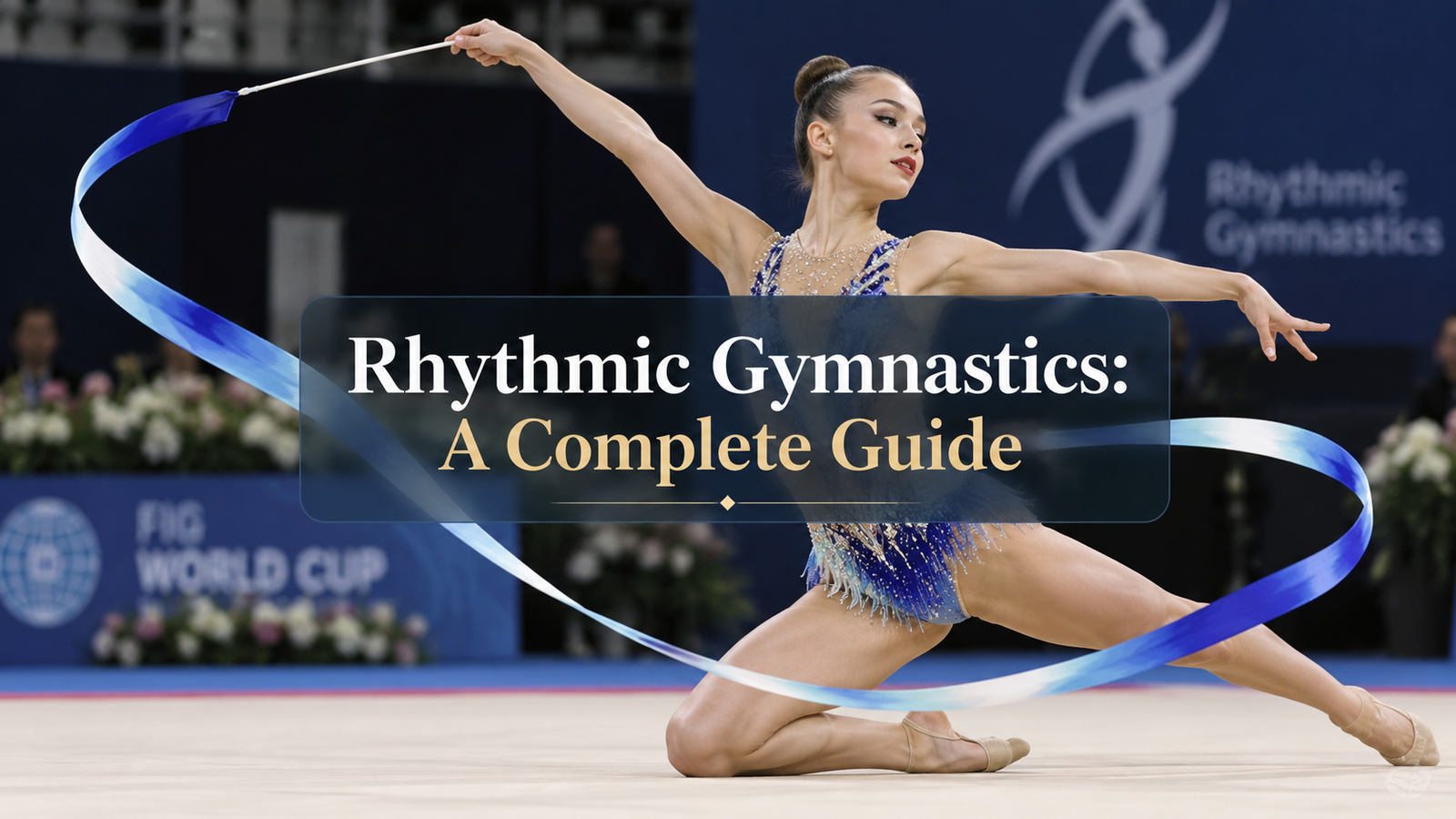
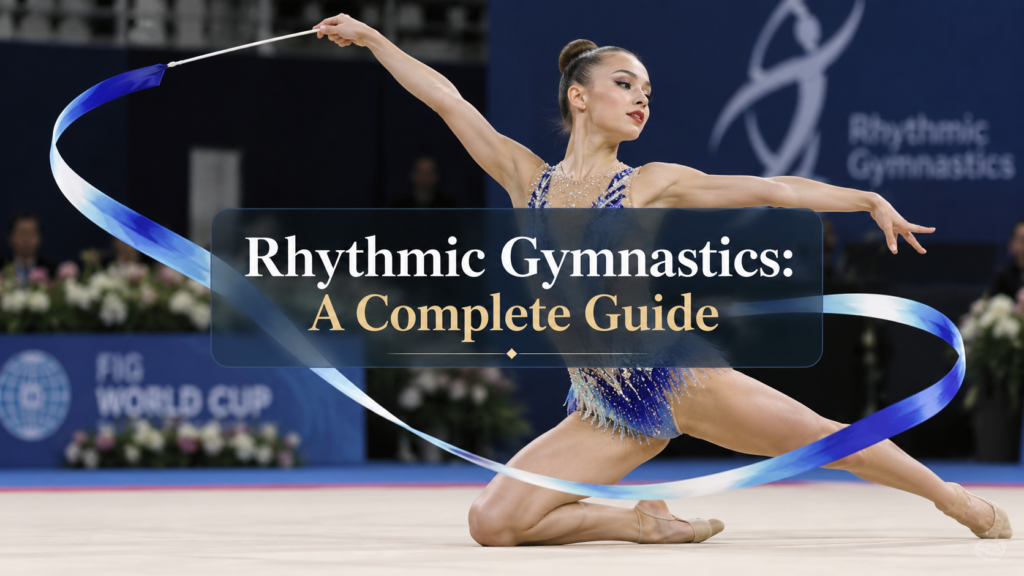
The ribbon is one of the most visually dramatic apparatus used in rhythmic gymnastics.
The gymnast uses a stick attached to a long ribbon. By moving the stick, she creates spirals, circles, waves, snakes, and large flowing patterns.
The ribbon must remain active and controlled throughout the routine. If it becomes tangled or touches the floor incorrectly, the performance may lose quality.
Ribbon routines require continuous arm movement, good rhythm, and precise control.
Important Skills in Rhythmic Gymnastics
A rhythmic gymnast develops a wide range of physical and technical abilities.
Flexibility
Flexibility is extremely important because many routines include deep back bends, leg extensions, splits, and high kicks.
However, flexibility should develop gradually. Proper warmups and controlled stretching are essential because forcing a stretch can increase the risk of injury.
Balance
Gymnasts often perform difficult positions while standing on one foot or rising onto the toes.
They may also control an apparatus while balancing, which makes the movement even more challenging.
Good balance depends on body awareness, strength, posture, and concentration.
Coordination
Rhythmic gymnastics requires the arms, legs, eyes, and apparatus to work together.
A gymnast may throw a hoop, complete a turn, and catch the hoop immediately afterward. These actions require careful timing and coordination.
Strength
Although rhythmic gymnastics is commonly associated with flexibility, strength is equally important.
Strong legs help with jumps and leaps. Core strength supports balance and posture. Strong shoulders and arms help the gymnast control the apparatus.
Strength training also supports safer movement.
Agility
Quick changes of direction are common during routines.
The gymnast may transition from a leap to a turn, then move across the floor to catch an apparatus.
Agility helps athletes perform these transitions efficiently.
Musicality
Music plays an important role in rhythmic gymnastics.
The movements should match the rhythm, mood, and structure of the music. A strong gymnast does not simply perform difficult skills while music plays. The choreography should appear connected to the sound.
Musical understanding can make a routine more expressive and enjoyable to watch.
Jumps and Leaps
Jumps and leaps are major elements of rhythmic gymnastics.
During these movements, the gymnast leaves the floor and demonstrates height, flexibility, shape, and control.
Some leaps include split positions, turning actions, or leg changes.
Good technique begins with a strong takeoff. The gymnast must then create a clear body position in the air and prepare for a controlled landing.
Landing technique is particularly important because repeated hard landings can place stress on the ankles, knees, and hips.
Turns and Rotations
Turns require balance, body alignment, and control.
A gymnast may rotate while standing on one foot with the other leg held in a specific position.
Some turns involve multiple rotations.
The gymnast must maintain posture and control while keeping the movement connected to the music and apparatus.
Spotting techniques and regular balance practice can help improve turning ability.
Body Waves and Flexibility Movements
Body waves are flowing movements that travel through different areas of the body.
They may begin from the chest, spine, hips, or legs.
These movements create the smooth style associated with rhythmic gymnastics.
Flexibility movements may involve back bends, leg holds, oversplits, and large extensions.
Although these movements can look effortless during competition, they require careful training and strong muscular control.
Apparatus Handling
Controlling the apparatus is one of the biggest challenges of rhythmic gymnastics.
A gymnast must learn how to throw, catch, rotate, bounce, roll, and move each apparatus while performing body skills at the same time.
For example, a gymnast might throw the ball into the air, perform a leap underneath it, and then catch it without interrupting the routine.
Apparatus skills are practiced repeatedly so they become consistent.
Beginners normally start with basic handling before progressing to complex throws and catches.
Individual Rhythmic Gymnastics
Individual routines feature one gymnast performing alone.
The gymnast is responsible for every element of the performance, including body movements, apparatus handling, timing, expression, and use of the floor area.
Individual competition allows athletes to demonstrate their personal style and strengths.
Some gymnasts may be especially strong in flexibility, while others may be known for powerful leaps, expressive choreography, or exceptional apparatus control.
Group Rhythmic Gymnastics
Group rhythmic gymnastics is performed by several athletes together.
These routines require teamwork, synchronization, and precise spacing.
Gymnasts may exchange apparatus by throwing it to one another or create formations across the floor.
Every athlete must know exactly where to move and when to perform each action.
A small timing mistake can affect the entire group routine.
Because of this, group training often focuses heavily on communication and repetition.
Training for Rhythmic Gymnastics
Rhythmic gymnastics training usually includes several different areas.
A typical training session may begin with a general warmup followed by flexibility exercises.
The gymnast may then practice balances, turns, leaps, jumps, and body waves.
Another part of training focuses specifically on apparatus handling.
Athletes may practice throwing and catching the ball hundreds of times or repeat ribbon patterns until they become smooth.
Choreography practice combines the separate skills into a complete routine.
Strength and conditioning exercises may also be included to improve physical preparation.
Importance of Warmups
A proper warmup prepares the body for difficult movements.
Light jogging, controlled joint movement, dynamic stretching, and basic gymnastics exercises can gradually increase body temperature and blood flow.
Gymnasts should avoid immediately attempting extreme flexibility positions when the body is cold.
A structured warmup may help improve movement quality while reducing unnecessary strain.
Flexibility Training
Flexibility develops gradually through consistent practice.
Gymnasts often work on the hamstrings, hips, shoulders, back, and legs.
Static stretching may be used after the body is warm, while dynamic flexibility exercises are often included earlier in training.
The goal should not be flexibility alone. The gymnast must also have enough strength to control flexible positions.
Controlled flexibility is generally more useful than simply being able to reach an extreme position.
Strength and Conditioning
Strength training supports nearly every rhythmic gymnastics skill.
Core exercises help maintain body alignment during balances and rotations.
Leg exercises support jumping, landing, and stability.
Upper body exercises help with apparatus control and posture.
Conditioning also improves endurance, allowing gymnasts to maintain performance quality throughout a routine.
Training should be appropriate for the athlete’s age, experience, and development.
Common Challenges for Beginners
New rhythmic gymnasts often discover that controlling the apparatus while moving is more difficult than it looks.
A beginner may be able to perform a simple leap and a simple ball throw separately but struggle when combining the two.
Timing is another common challenge.
It takes practice to coordinate movement with music while remembering choreography.
Flexibility development can also take time.
Beginners should avoid comparing their progress with advanced athletes who may have trained for many years.
Steady improvement is more important than rushing into difficult skills.
Safety in Rhythmic Gymnastics
Safe training is important at every level.
Gymnasts should learn difficult skills gradually and preferably under qualified supervision.
Training areas should be clear of unnecessary obstacles.
Proper warmups, suitable footwear when required, good technique, adequate recovery, and careful progression can all contribute to safer practice.
Athletes should also pay attention to persistent pain rather than repeatedly training through it.
Rest is part of physical development and helps the body recover between demanding sessions.
Benefits of Rhythmic Gymnastics
Rhythmic gymnastics can provide many physical and personal benefits.
It helps improve flexibility, balance, coordination, posture, body awareness, and endurance.
Regular practice can also improve concentration because athletes must remember detailed choreography and react quickly to apparatus movement.
Group training can encourage teamwork and communication.
Performing in front of others may also help athletes become more comfortable with presentation and competition environments.
Most importantly, rhythmic gymnastics provides a creative way to combine sport, music, and artistic expression.
Rhythmic Gymnastics for Children
Many children begin rhythmic gymnastics at a young age.
Beginner classes usually focus on simple movements, basic coordination, safe flexibility, and fun apparatus activities.
Young gymnasts may practice rolling a ball, spinning a hoop, creating ribbon circles, or learning simple jumps.
The early goal should be to develop movement skills and enjoyment rather than immediately focusing on advanced competition.
A positive training environment can help children build confidence and stay motivated.
Rhythmic Gymnastics Competitions
In competition, routines are evaluated according to established rules.
Judges consider factors such as difficulty, execution, artistry, apparatus handling, body technique, and overall presentation.
Mistakes can affect the final score.
Examples may include dropping the apparatus, stepping outside the competition area, losing balance, or performing a skill incorrectly.
High level routines usually combine considerable technical difficulty with precise execution and strong artistic presentation.
The best performances make difficult movements appear smooth and connected.
Difference Between Rhythmic and Artistic Gymnastics
Rhythmic and artistic gymnastics are related sports, but their competitive formats are very different.
Artistic gymnastics includes events such as floor exercise, vault, bars, rings, and balance beam, depending on the competition category.
Rhythmic gymnastics focuses on floor routines performed with handheld apparatus and music.
Artistic gymnastics generally emphasizes tumbling, power, strength, swings, and acrobatic skills.
Rhythmic gymnastics places greater emphasis on flexibility, dance, apparatus control, musical interpretation, and continuous movement.
Both sports require years of disciplined training.
How Beginners Can Start
Someone interested in rhythmic gymnastics should begin with basic movement skills.
Learning posture, balance, simple leaps, basic turns, and safe stretching creates a strong foundation.
Beginners can then practice simple apparatus skills, such as rolling a ball, circling a hoop, or making basic ribbon patterns.
Joining a qualified gymnastics club is usually the safest way to learn because coaches can correct technique and introduce skills progressively.
Regular practice matters more than trying to learn everything quickly.
Keeping training enjoyable can also help beginners remain motivated.
Final Thoughts
Rhythmic gymnastics is a unique sport that combines athletic ability with music, dance, creativity, and precision. Its beautiful appearance can make the sport seem effortless, but every routine requires significant physical preparation and technical practice.
Gymnasts must develop flexibility, balance, strength, coordination, endurance, apparatus control, and musical awareness. They must also learn how to connect difficult movements smoothly while maintaining expression and confidence.
From elegant ribbon patterns to fast club exchanges and controlled ball movements, every apparatus brings a different challenge.
For beginners, the most effective approach is to build strong fundamentals, practice consistently, develop flexibility safely, and progress gradually. With patience and proper instruction, rhythmic gymnastics can become an enjoyable activity that develops both physical skills and artistic expression.
Whether practiced recreationally or competitively, rhythmic gymnastics offers a distinctive combination of movement, discipline, creativity, and performance that continues to attract athletes and audiences around the world.